

Feature for Guardian Philosophy
For much of the past century, photojournalism has been understood as the practice of documenting events. For Stefan, it has always been something more demanding: a philosophical exercise in attention. Every photograph begins not with the camera, but with a question.
That instinct—to interrogate rather than simply observe—has defined a career spanning decades of journalism, international reportage and cultural commentary. Yet it is not the images themselves that preoccupy him most today. It is the ideas behind them: how technology reshapes perception, how truth becomes contested, and why curiosity has become one of the most undervalued virtues of the twenty-first century.
“I’ve always asked why,” he says. “Why do we accept certain systems? Why do we call something true? Why should justice look one way rather than another? Those questions have stayed with me far longer than any photograph.”
It is an unusually philosophical starting point for someone whose career was built behind the camera. Beginning as a sports photographer in the 1980s before moving into international reportage and later working for one of Sweden’s leading daily newspapers, Stefan witnessed extraordinary political, cultural and technological transformations through the viewfinder. Yet experience has only reinforced his scepticism of certainty.
Photography, he argues, has never been an objective witness. It is an interpretation.
That observation feels especially urgent today.
We live in an age saturated with images yet increasingly uncertain about what constitutes evidence. Artificial intelligence generates photographs of events that never occurred. Algorithms curate our realities before we have time to question them. The camera, once associated with documentation, has become another instrument through which competing versions of truth are manufactured.
Against this backdrop, Stefan believes philosophy has become less an academic discipline than a civic necessity.
“The greatest challenge isn’t technology itself,” he reflects. “It’s whether our capacity for critical thinking develops as quickly as the tools we’re creating.”
His perspective offers a welcome antidote to both technological utopianism and dystopian fatalism. Rather than treating innovation as either salvation or catastrophe, he sees it as an amplifier of human intention.
Technology, he argues, is ethically neutral.
People are not.
Looking to Scandinavia, he identifies a familiar paradox. The region continues to lead in digital innovation and public infrastructure, yet often remains culturally cautious, favouring institutional stability over disruptive experimentation. Elsewhere, emerging economies are adopting technological change at a far greater pace and with greater flexibility, redefining assumptions about where innovation originates.
“Large institutions often move slowly,” he says. “Smaller organisations adapt because they have to. Agility has become one of the defining advantages of our time.”
His reflections extend beyond economics into political philosophy itself. As artificial intelligence reshapes labour, public discourse and democratic participation, Stefan suggests that society risks becoming technically sophisticated while intellectually complacent.
The problem, he insists, is not information.
It is interpretation.
Knowledge has never been more abundant. Wisdom, by contrast, remains stubbornly scarce.
This distinction lies at the centre of his worldview. Photography taught him that seeing is never the same as understanding. Philosophy merely gave him the language to explain why.
In an era dominated by certainty—political certainty, technological certainty, ideological certainty—Stefan advocates something considerably less fashionable: intellectual doubt.
Not cynicism.
Curiosity.
It is perhaps the oldest philosophical lesson of all. Socrates believed wisdom begins with recognising the limits of one’s own knowledge. More than two millennia later, that proposition feels unexpectedly radical.
As artificial intelligence, surveillance technologies and algorithmic decision-making continue to reshape everyday life, Stefan’s reflections offer a timely reminder that progress cannot be measured solely by computational power or economic growth.
The future will belong not simply to those who build better technologies, but to those willing to ask better questions.
And perhaps that is the most important lesson a photographer can leave us with: before changing the world, learn how to look at it.
DT 500 ZINE: -Stefan, casting back to your early days, can you recall the seminal moment when your first philosophical inquiry sparked? What ignited your quest for deeper understanding?”
STEFAN:-
” Why? Why do we need to learn this in school? Why should I listen to and obey your rules? Why do you believe there is truth or justice? Why do people think life has a purpose? From the start, I always ask myself and others that question.”
DT 500 ZINE: – What was the pivotal moment that ignited your fascination with cultural dynamics? How did you first feel the pulse of societal shifts and cultural currents?
STEFAN: – I fell in love with photojournalism in the 80s, and it was more about travelling and experiencing things most people read about than about photography as art. I started by shooting sporting events in my hometown. That way, I learned to be fast with my camera equipment (no auto-focus or auto-exposure in those days), and eventually, I managed to get published in local newspapers. When I was 18, I was experienced enough to get an internship at Expressen, Sweden’s largest daily at the time, and from there on, it became my profession for 12 years.
“One of the most important things I learned is to believe in myself and my ability to handle every situation. This is probably why it is much safer to freelance than to have a boss.
DT 500 ZINE: – Share with us your perspective on global technological advancement in contrast to the innovation landscape in Scandinavia and Sweden. How do you perceive the differences in approach and impact?
STEFAN: – The interest in and understanding new technology differs between developed and developing countries. Scandinavia and other advanced areas focus on tech from the efficiency perspective and are often afraid of disrupting old business models, leaders, and ideas. People in developing countries have less to lose.
“so I believe a lot of interesting technology trends will start among people new to connectivity.”
DT 500 ZINE: – Right vs Wrong today?
STEFAN: –
“It is wrong to believe that people must work to create value. It is wrong to compete in a network society. It is wrong to think you accomplished anything on your own. It is right that technology can create abundance. It is right that everyone and everything in this universe is interconnected. It is right that time is all we have.”
STEFAN: – It used to be essential to be big – the bigger, the better. But the speed of change is increasing, and big is slow. Today, big corporations need a growing disconnect with customers, constant reorganisation and an inability to innovate, while small companies with extensive networks are fast and close to all stakeholders.
“Crowdsourcing and crowdfunding are always there as an option, so the important difference between the one-man band and big corporations is flexibility. No one is alone, so fast is the new big.”
DT 500 ZINE: – Can you articulate your definition of courage? How do you perceive this quality and its significance in navigating personal and professional challenges?
STEFAN: – Courage is as courageous does (to paraphrase Forrest Gump’s mother)
DT 500 ZINE: – Well, Stefan, you’ve got a knack for wit. Let’s talk about self-esteem. How do you view its importance and impact on personal growth and achievement?
STEFAN: – You have to love yourself. As humans, we are aware of and can think about our existence.
“But what are you? Is it your body? It changes constantly or did you actually mourn the last time you had a haircut and part of you died? When you think about your existence, you realise that you are the creation of your thoughts and are possessed about yourself. You think about you all the time.”
STEFAN: – Every human being is like this. Why do you think selfie sticks are so popular? So, if you have low self-esteem and are mean to yourself, you will create a bad you. Your body will die, so the risk you take is not loving life while you have a chance. Being alive is being a risk-taker.
DT 500 ZINE: – Stefan, you clinched the prestigious ‘Speaker of the Year’ accolade in 2014. Could you provide a concise overview of your insights into the impact of innovation, disruptive technologies, and changing behaviours on both business dynamics and societal issues?
STEFAN: – The speed of change increases when more people have access to technology (new opportunities) and are affected by a dysfunctional economy (new problems). So old business models and empires are dying faster than before, not because leaders are bad at what they do but because they are good at providing the wrong solution. This sounds scary, but it is excellent news since we have enormous problems with limited resources and a growing population. We need new solutions fast. Then, I will provide up-to-date examples of how new opportunities are changing our world and what successful companies are doing.
DT 500 ZINE: – Your fascination with change and the future is evident. How do you envision it unfolding? What are your insights into the potential trajectories and transformative shifts ahead?
STEFAN: –
“I think of the future of an island. Crystal clear waters, blue sky, and sunshine, the future is paradise! No food, drinking water, or friends; the future is hell! Utopia vs dystopia, cyclic vs disruptive…The future will be all of these, and the important question is not about predictions but why you do what you do. Will your actions take us to paradise or to hell? What is the point of being pessimistic? If everyone joins the Preppers – people who invest in guns and store food to prepare for Armageddon – then that’s what the future will be like. I think connectivity will ultimately lead to the end of the hierarchy, and that’s the revolution.”
DT 500 ZINE: – Do you have a metaphysical theory? How do you perceive the evolving understanding of existence and reality?
STEFAN: – Humans gradually change how we think about the world. The standard today was unbelievable 100 years ago, and people alive then would freak out entirely if you could get them here instantly. The same goes for us.
“We think it is expected to have a hearing device, but it is scary to talk about cyborgs. The singularity will come, and defining an actual human being will be impossible. We will be able to download our minds and thereby be able to share and move memories and experiences between hosts (bodies).
DT 500 ZINE: – Who has been your guiding influence or mentor throughout your career?
STEFAN: – Nature is my source of inspiration and my mentor. I don’t follow the news and try to keep the information private. Of course, I dig for information when I do research.
“but the most important pieces always come from thinking and reflecting. We all like to think that we are unique, especially in business, but there is no difference in all the titles and labels; they are all the same, and there is nothing new.”
DT 500 ZINE: – Do you foresee a political system evolving in the future? What are your thoughts on the potential transformations in governance?
STEFAN: – I believe democracy will become liquid. With everyone networked, we can delegate voting power on a micro level to the ones we think are most competent, and with blockchain technology, we can verify every power transaction.
DT 500 ZINE: – What grand designs are you plotting next?
STEFAN: – My focus now is to lecture more outside the Nordics to meet with a global audience. This spring, I am taking on my first assignments outside Europe.
DT 500 ZINE: – takkar Stefan!
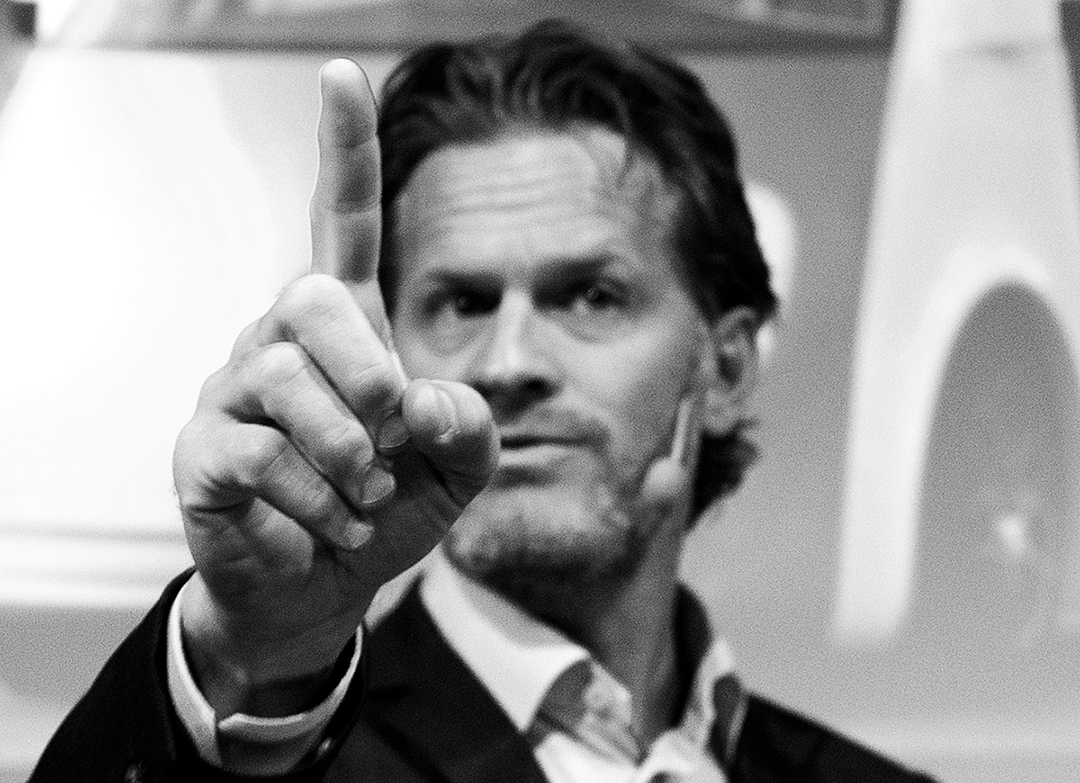
INTERVIEW BY © Arthur Sopin and Andreas Rod
 #dt500mag