ANTHONY LISTER: OUIJA LOWBROW ART

Where street mythology collides with contemporary anxiety.

For more than two decades, Anthony Lister has occupied one of contemporary art’s most elusive territories: the unstable ground between the gallery wall and the city street. Neither comfortably institutional nor entirely underground, the Australian artist has cultivated a visual language that treats graffiti, comic-book iconography, expressionist painting and internet-age mythology as equal cultural currencies.

Now returning to Sydney with a major new body of work, Lister once again dismantles the hierarchy between so-called “high” and “low” art. His paintings arrive like psychic graffiti—restless, instinctive and deliberately unresolved—where masked figures, fractured superheroes and ghostly apparitions drift through canvases that feel simultaneously ancient and unmistakably digital.

Long before today’s art market embraced street culture as luxury commodity, Lister was already interrogating its contradictions. His practice has never been about beautifying rebellion. Instead, it exposes the uneasy relationship between authenticity, spectacle and consumption in an age where every subculture risks becoming a brand.

The new exhibition pushes that conversation further. Borrowing the ritualistic symbolism suggested by its title, Ouija Lowbrow Art explores spirituality not as organised belief, but as cultural séance—summoning fragments of collective memory, popular mythology and urban folklore into volatile painterly encounters. Here, Western pop culture becomes both idol and ghost, simultaneously seductive and exhausted.

“I wanted these works to feel like conversations with things we thought we’d buried,” Lister explains. “They’re about belief, identity and the strange mythology we’ve built around ourselves.”

Executed with the immediacy of graffiti and the emotional volatility of Abstract Expressionism, Lister’s paintings reject technical perfection in favour of instinct. Their deliberately awkward gestures, drips and distortions become acts of resistance against an increasingly polished visual culture dominated by algorithms and digital perfection.

In an art world increasingly seduced by immaculate production values and market-friendly aesthetics, Lister continues to champion imperfection as a political language. His paintings refuse closure. They ask viewers to inhabit uncertainty rather than consume certainty.

That refusal has defined an international career spanning major exhibitions across Australia, Europe, the United Kingdom and the United States, where Lister has emerged as one of the most influential figures to bridge street art and contemporary painting without allowing either to dilute the other.

His practice now feels more prescient than ever. As contemporary culture wrestles with questions of authenticity, identity and the commodification of rebellion, Lister’s work reminds us that painting remains one of the few places where contradiction can still exist without apology.

Ouija Lowbrow Art is less an exhibition than a cultural exorcism—an invitation to confront the myths we inherit, the icons we consume and the ghosts that continue to haunt contemporary life. It is painting at its most instinctive, most unruly and, perhaps, most honest.
01868-300


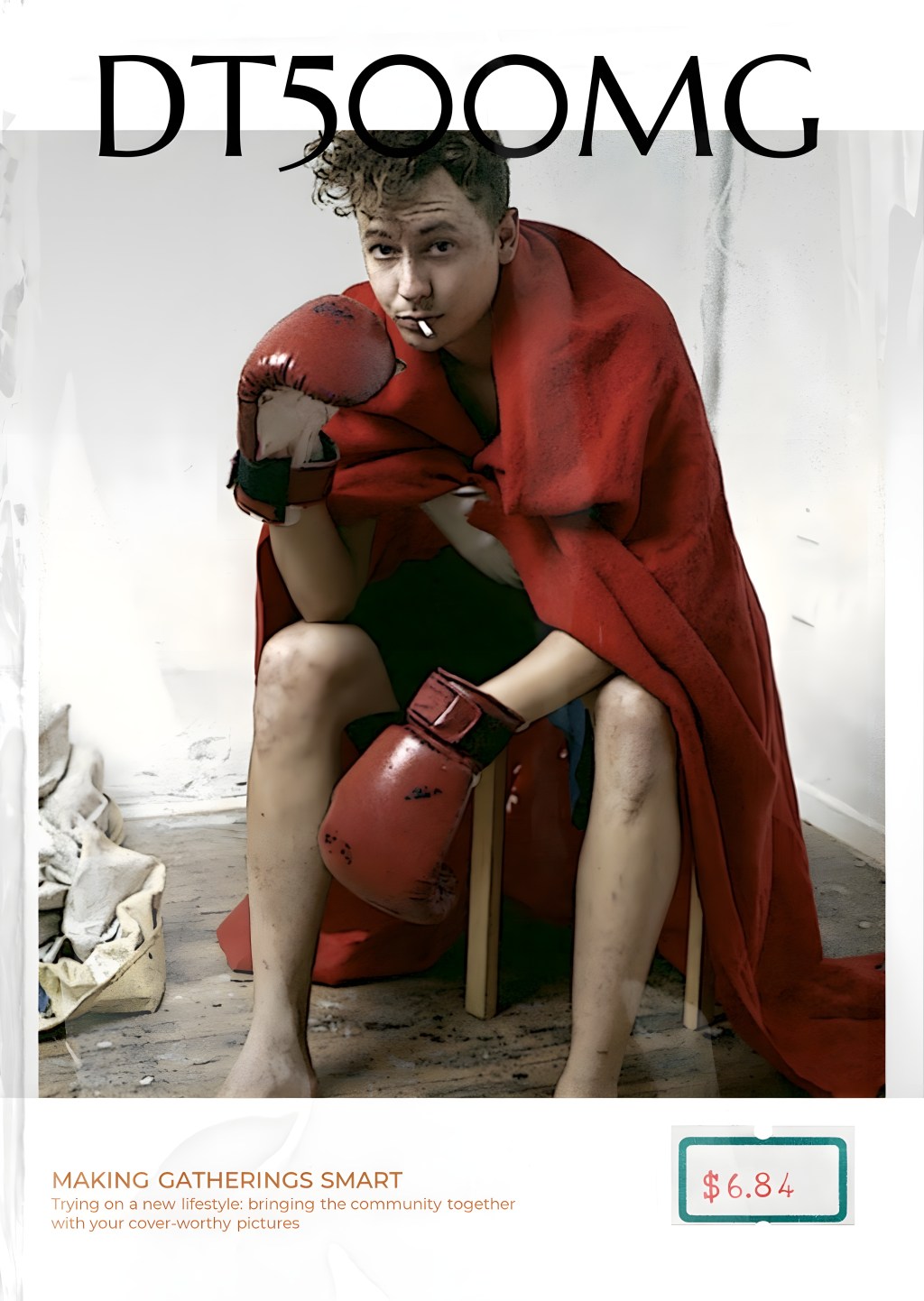
DT 500 ZINE:  –Deep admirers of your artistry, we at Downtown 500 Zine are eager to delve into your backstory. Could you share with us some insights into your upbringing and early influences?

ANTHONY:  I was born in Australia and raised by a single mum. I am the middle boy of three.

“Comic books, skateboarding, first job at 10.”

DT 500 ZINE:- How did you initially discover and nurture your creative impulses, shaping them into the distinctive artistic voice that defines your work today?

ANTHONY: – Through years of boredom.

“Scratching, which turned into doodling, which turned into sketching.”

DT 500 ZINE:  –Anthony, when it comes to the dichotomy of fine art versus lowbrow, where do you stand? How do you perceive the legacy and impact of lowbrow art in today’s cultural landscape?

ANTHONY:

“In my mind, there are 2 art worlds, the art world where art is made and the art world where work is seen to have been made. I prefer to exist in the art world where art is made.”

DT 500 ZINE: – Could you please clarify the context or provide more details about what you mean by “What is your state?” It seems ambiguous in this conversation.

ANTHONY: – My mess is my message.

“It takes a lot of balls to cut your own di** off. I’m not trying to change the world; I’m just reacting to a world trying to change me.”

DT 500 ZINE: – Any advice on how to enhance one’s inspiration?

ANTHONY: – First of all, I’d like to mention Lucian Freud and how beautiful a painter he was. Lucian did a lot of paintings, and Lucian inspired me. Secondly, I’d like to suggest Chuck Close and his statement where he says:

“Inspiration is for beginners; the rest just get to work.”

DT 500 ZINE: – What might be the subject of your latest endeavour?

ANTHONY:  Ouija boards have always freaked me out, so I decided to make a body of work about having experience talking with the spirits myself.

DT 500 ZINE: –  On what themes does your work primarily centre?

ANTHONY: My work focuses on concepts of contemporary philosophy based on observations of my surroundings and society. 

“I’m interested in analogies and, more importantly, communicating.”

DT 500 ZINE: – What grand ambitions do you harbour for the future of your illustrious career, and how do you envision your work evolving in the coming years?

ANTHONY: – To echo eternity is obviously every painter’s dream.

“More directly, I would like to be invited to install large-scale bronzes in the public domain.”

DT 500 ZINE: – What forthcoming ventures and aspirations are you most eagerly anticipating in the near future?

ANTHONY:  After my Ouija board show next week, I will do some public commissions and then travel to Europe for a residency later this year; a show in London and France is planned. My website is expanding, I’m moving studio, a movie is being made, and I’m working with holographic. That will keep me busy.

DT 500 ZINE: – Stay industrious, Anthony. Many thanks for your time, and we look forward to our next encounter!

ANTHONY LISTER:

THE FIRST RULE OF PAINTING IS TO TAKE EVERYONE ELSE OUT OF THE EQUATION. I AM THE VIEWER, SO I DON’T UNDERESTIMATE MY VIEWERS. THEY SEE EVERYTHING, AND I JUST HAVE TO ASSUME THAT THEY ARE ME. I CAN’T PAINT FOR ANYONE ELSE. IT’S ALL ABOUT HAVING THE COURAGE TO SAY THIS IS FINISHED AND THEY HAVE TO KNOW THAT I AM THE BOSS OF PAINTING. It’s LIKE BEING A SOLDIER BECAUSE I HAVE TO BE HARD AS FUCK TO FALL IN LOVE WITH THESE THINGS AND LET THEM GO.

#LOWBROWO!

Lister’s interview with Downtown 500 Zine offers a rare glimpse into the personal motivations behind his acclaimed career. From early scribbles to international acclaim, Lister’s journey exemplifies a relentless pursuit of creativity and a commitment to challenging artistic norms.

59_00213
Q & A

01868-300

Interview by © Arthur Sopin
Images  Q & A