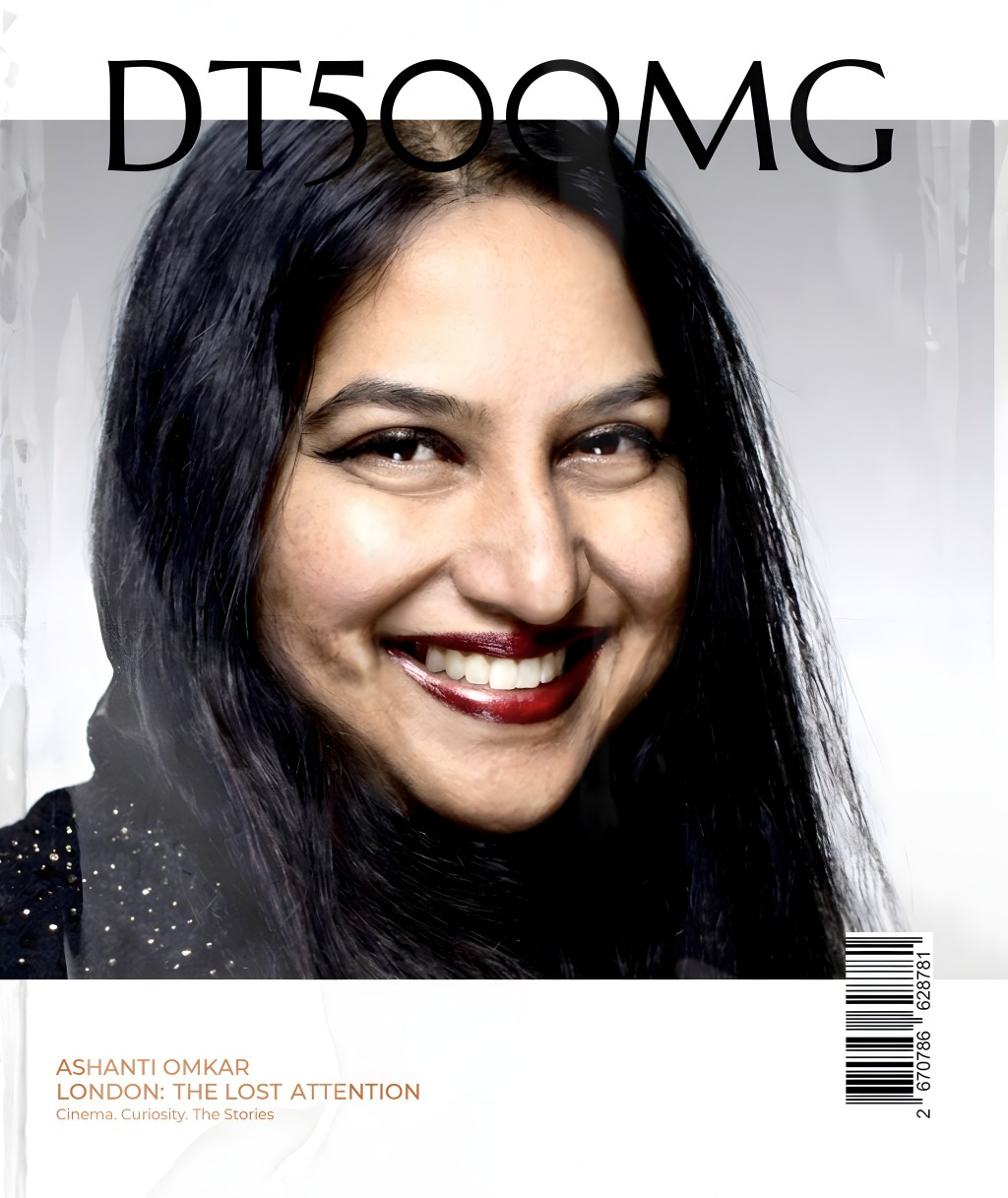
By Arthur Sopin | DT500 Magazine
Before Ashanti Omkar discusses algorithms, cultural criticism or the future of cinema, she returns to a moment when a film changed the way she understood reality.

It was not simply the spectacle of The Matrix that stayed with her, but the deeper philosophical questions hidden beneath its science-fiction surface. For Omkar, the film’s exploration of ideas connected to Hindu Advaita Vedanta philosophy created a rare cinematic experience — one where entertainment became a doorway into questions of consciousness, identity and perception.
“I’d not seen a film prior to this which explored this kind of deep concept,” she recalls.
Years later, after a career spent interviewing actors, filmmakers, composers and cultural figures, that sense of discovery remains at the centre of her work. For Omkar, cinema is not simply something audiences consume. It is something that changes the way people see themselves and the world around them.
In an era where culture is increasingly experienced through fragments — short clips, algorithmic recommendations and instant reactions — Omkar represents a different kind of cultural voice: one built around attention, curiosity and conversation.
A broadcaster, film and television critic, event moderator, curator and voiceover artist, she has developed a multidisciplinary career across the creative industries. Her work exists at the intersection of cinema and communication: introducing audiences to stories, analysing cultural movements and creating spaces where artists and audiences can meet.
“I’ve never pigeonholed myself,” she explains. “I have crafted a multidisciplinary portfolio career since leaving the corporate world.”
Rather than belonging to a single category, Omkar describes herself as a “culture analyst, a culture shaper and a tastemaker” — someone working across broadcasting, criticism, moderation and cultural events to help stories reach wider audiences. Alongside her professional work she also donates significant time to voluntary pro bono jury service as a contribution to cinema and the filmmaking community. She has served on the BAFTA Film Jury four times (2023–2026) and has sat on juries and committees for Series Mania, the Royal Television Society, Raindance, Women in Film & Television, Sundance London, the Asian Academy Creative Awards, BASE, the Kerala International Film Festival and the Hollywood Critics’ Choice Awards, as well as previously serving for many years on the awards committee of the UK Critics’ Circle.
The person behind the performanc
One of the great mysteries of cinema is the relationship between the performer and the person behind the performance. Audiences become familiar with characters long before they encounter the individuals who create them.
For Omkar, interviews have repeatedly revealed the difference between public image and private personality.
She recalls her conversation with actor Golda Rosheuvel for a cover story with The Big Issue. Having watched Rosheuvel command the screen as Queen Charlotte in Bridgerton, Omkar expected a similarly composed and dramatic presence.
Instead, she encountered something very different.
“I was expecting her to be somewhat like her famous stoic, dramatic character of the Queen in Bridgerton,” she says. “Yet I saw her natural and true warmth shining through.”
The experience revealed something fundamental about great acting: the ability to make audiences believe completely in a character while remaining entirely separate from it.
“Meeting her in real life, I saw her humour and genuineness plus realised how she’s an excellent actor who can make us believe her character so completely. That is the power of great actors who essay great characters.”
For Omkar, this understanding shapes the way she approaches interviews. The purpose is not simply to obtain a memorable quote, but to create an environment where people can reveal something authentic.
“Listening to learn and have meaningful conversations, rather than just to reply, is one of the most underrated skills in on-stage moderation and interview technique.”
In a media landscape increasingly driven by speed, listening itself has become a form of cultural practice.
The battle for attention
The defining challenge of contemporary culture may no longer be access. Audiences have more films, series and creative works available than any generation before them.
The challenge is whether people still have the patience to fully experience them.
“The ‘second screen’ scrolling phenomenon is very much in play these days,” Omkar says.
The boundaries between cinema, television and personal technology have changed dramatically. Outside traditional cinema spaces, audiences increasingly divide their attention between storytelling and digital distraction.
“People’s attention is divided between their devices, and it means that the finer details of the films or shows that people work so hard to create are diluted in viewers’ minds.”
For Omkar, this is not simply a question of etiquette. It is a question of cultural depth.
“We are perhaps losing nuance in the way we consume and enjoy cinema, and diluting the discourse too.”
The danger is that stories become reduced to moments rather than experiences — a scene extracted from its context, a reaction replacing reflection, an opinion arriving before understanding.
The question facing culture today is not whether audiences have access to stories. They have more access than ever before.
The question is whether they still allow stories enough time to transform them.
Curiosity in the age of algorithms
Recommendation systems increasingly promise to understand audiences before they understand themselves. Streaming platforms, social networks and search engines continuously predict what people might enjoy next.
But can genuine curiosity survive when discovery becomes automated?
For Omkar, there is no simple answer.
“This depends on the kind of person,” she says. “We all have access to what’s fed to us.”
Some audiences may follow algorithmic pathways easily, while others actively search beyond recommendations.
“There is no right or wrong to this, as consuming art comes from curiosity in the first instance, but how, what and where can be driven by the algorithm, and it may or may not give the best learnings to the consumer.”
The challenge is not rejecting technology, but maintaining independence within it.
Algorithms can introduce audiences to unexpected stories, but they can also create cultural comfort zones where people repeatedly encounter only what they already know.
Curiosity requires the willingness to be surprised.
The responsibility of criticism
The rise of social media has transformed cultural conversation. Everyone can now publish an opinion instantly, but Omkar believes there remains a distinction between reaction and criticism.
“For me, this boils down to analysis and the knowledge of the critic.”
She argues that criticism requires more than personal response. It requires context, understanding and responsibility.
“I see journalism and film critique as two different things, with the former being very factual and the latter being opinion based.”
The strongest cultural voices, she suggests, understand both worlds: they can analyse creatively while maintaining accuracy and awareness of the industries they examine.
“Marrying these two things to an extent, and broadcasting and writing accurately, is what showcases someone with credibility, expertise and experience.”
In a time when opinions often travel faster than reflection, thoughtful criticism becomes increasingly valuable.
Why festivals still matter
Film festivals remain among the few places where cinema exists as a shared cultural experience.
For Omkar, their importance lies not only in the films themselves but in the conversations that happen around them.
“The human connection can often be the most valuable,” she says.
Digital communication has expanded access, but it cannot fully replace physical encounters.
“Tone is unfortunately lost in digital communication, but this is something that festivals help with, when one gets to look into the white of one’s eyes and communicate with nuance and authenticity.”
Yet Omkar is not nostalgic for a pre-digital world. She has experienced the possibilities of online cultural spaces, including working on a fully digital festival during the pandemic with virtual premieres and filmmaker conversations.
The future of culture, she suggests, will not belong exclusively to physical or digital spaces, but to those who understand how to combine both.
Representation beyond visibility
Representation has become one of the defining cultural conversations of the modern era. However, Omkar believes the discussion must go beyond visibility alone.
“We are still missing acknowledging micro aggressions surrounding representation.”
These moments can appear through assumptions about names, heritage, careers or disability — small interactions that reveal larger cultural patterns.
True representation is not only about who appears on screen. It is about whose experiences are understood, respected and valued.
The films that explain the 2020s
If future generations wanted to understand what it felt like to live through the 2020s, Omkar believes cinema would provide a powerful archive.
Her choices reveal a decade concerned with identity, morality, technology and human connection.
“Greta Gerwig’s Barbie captures conversations around gender, expectation and identity through humour and imagination. Celine Song’s Past Lives explores migration, memory and the emotional complexity of belonging. Christopher Nolan’s Oppenheimer examines ambition, responsibility and the consequences of human invention.”
“Bong Joon Ho’s Parasite remains a defining examination of class inequality, while Guillermo del Toro’s Pinocchio explores mortality and humanity through a timeless story.”
“Ken Loach’s Sorry We Missed You captures economic pressures facing workers and freelancers, while Phil Lord and Christopher Miller’s Spider-Man: Across the Spider-Verse reflects a generation redefining creativity through animation and technology.”
Together, these films form a portrait of a decade searching for meaning amid rapid change.
Cinema as self-discovery
For Omkar, cinema has always been more than professional.
“Cinema has been my therapy, and it evolves in my mind, as my life journey continues.”
Storytelling, she believes, is fundamental to human existence.
“Storytelling is in human DNA, and good cinema brings it to life.”
That belief explains why curiosity remains the foundation of her work.
“Human beings, I believe, are born curious, hence the development through the ages, in technology and in the way of life.”
The question that drives discovery is simple:
“ What if ? ”
In a cultural landscape increasingly shaped by prediction, automation and endless choice, Omkar’s message is ultimately about protecting the instinct that makes creativity possible.
Algorithms may influence what audiences discover. Platforms may shape what becomes visible.
But curiosity remains uniquely human.
Because the stories that matter are not only the ones we watch.
They are the ones that continue changing the way we see.
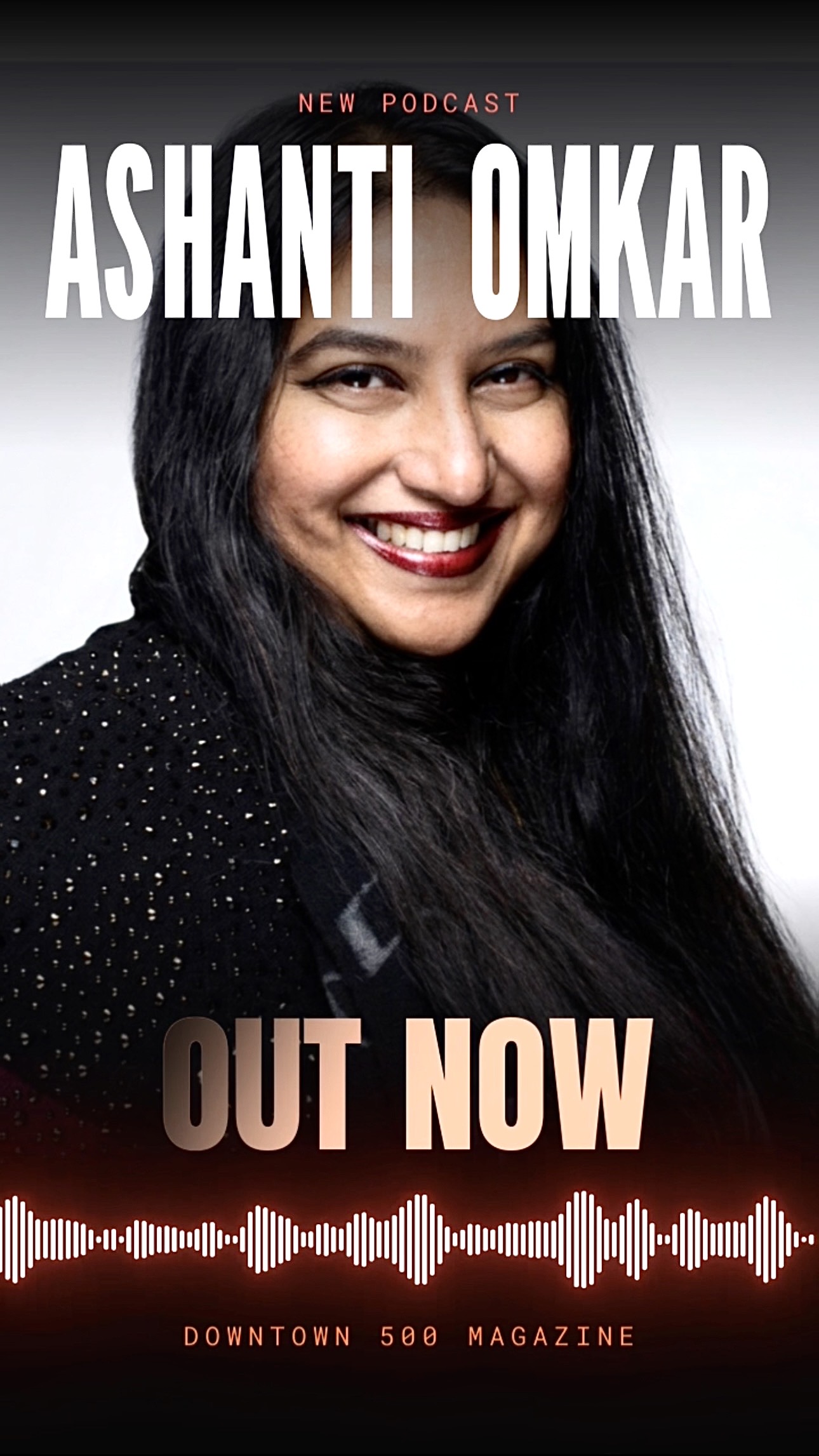
Voiceover reel: Ashanti Omkar voice reel
 #dt500mag