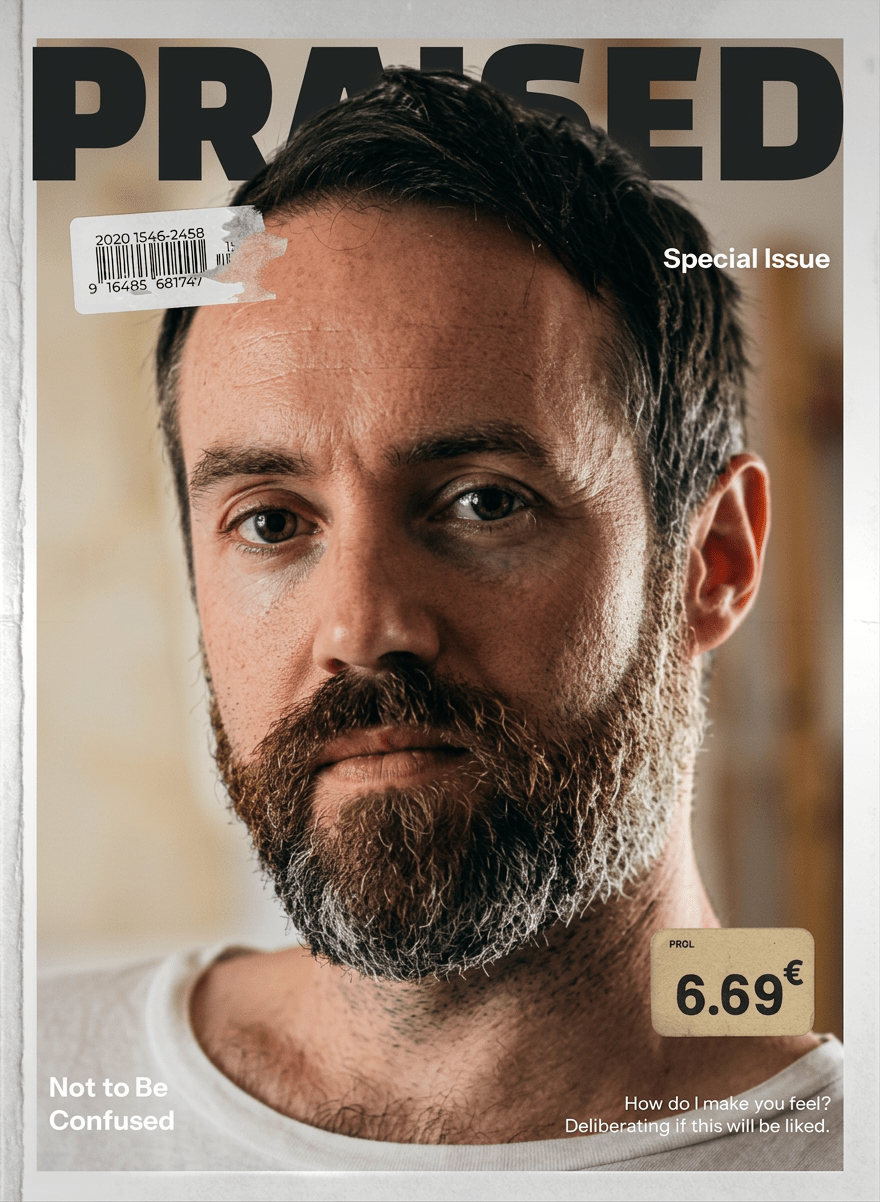
Embark on a Visual Odyssey: Jo Bentdal and the Quiet Radicalism of “Common Sensibility”
There is a particular strain of contemporary photography that no longer seeks to document the world so much as to test the viewer’s capacity for attention. Jo Bentdal’s Common Sensibility belongs firmly in this register, where image-making becomes less an act of capture than a sustained philosophical pressure applied to perception itself.
Presented in an understated urban setting near Oslo’s civic core, the work unfolds with the quiet confidence of a proposition rather than an exhibition. Nothing announces itself loudly. Instead, Bentdal constructs a field of visual ambiguity in which photography ceases to function as evidence and begins to operate as a kind of thinking—unstable, recursive, and deliberately unresolved.
Bentdal’s trajectory, often summarised in reductive shorthand as a shift from physics to philosophy to image-making, is less biography than method. His photographs carry the residue of this intellectual migration: a persistent interest in systems, causality, and the limits of human interpretative frameworks. Yet what distinguishes Common Sensibility is its refusal to resolve this thinking into diagrammatic clarity. The work resists explanation in favour of sustained perceptual uncertainty.
Within the images, subjects appear neither fully symbolic nor entirely specific. They exist in a suspended condition—caught between observational clarity and conceptual drift. It is here that Bentdal’s sensibility becomes most evident: a disciplined avoidance of closure. The photograph is not allowed to stabilise into meaning too quickly; instead, it is held open, as if waiting for the viewer to complete its argument and failing that, to confront their own interpretative habits.
Helene Gulaker Hansen’s curatorial framing positions the series within a broader European discourse on perception, cognition, and the ethics of looking. Yet Bentdal himself resists the language of fixed interpretation. For him, the photograph functions as a site of encounter rather than instruction—an invitation to remain with ambiguity long enough for it to become generative rather than obstructive.
The intellectual architecture of the work draws lightly, but unmistakably, on philosophical traditions of shared perception and collective reasoning, though Bentdal refracts these references through a contemporary anxiety: the fragmentation of attention and the increasing automation of seeing. In this context, Common Sensibility reads less as a statement than as a test of endurance—of how long an image can resist being reduced into message.
What emerges is a body of work that occupies an unusual position within contemporary photographic discourse. It is neither overtly narrative nor formally detached; neither documentary nor purely conceptual. Instead, it operates in the interstice between these categories, insisting that meaning is not delivered but negotiated.
As Bentdal prepares his next body of work, tentatively titled The Law of the Instrument, the implications of this approach become sharper. The question is no longer what photography depicts, but what it does to the structures of thought that approach it.
In this sense, Common Sensibility does not present a world to be understood. It presents the conditions under which understanding itself becomes unstable.
Arthur –Our paths converged again in the backdrop of a bustling café, where intellectual fervour ignites the night like sparks. Joa, with your profound affinity for philosophy and your roots in physics, our rendezvous at Apotheke was nothing short of a guilty pleasure—an indulgence we both savoured. Our discourse, spanning the cosmic depths of quantum physics to the lofty domains of meta-themes, explored the realms of superhumans, progress, and the future.
-Our exchange transcended mere intellectual jousting; it unfolded as an enriching, effortless dialogue traversing vast expanses of thought. I recall vividly the candid insights you shared about the future and urban evolution, which pleasantly stirred our contemplations. Now, amidst the palpable tremors shaking our reality from all angles – pre-apocalyptic whispers in far-flung corners, economic tumult veering towards extremes, political discord reaching schizophrenic heights, and the looming spectres of religion and aversion – I find myself compelled to ask once more: what lies ahead?
-Are we on the cusp of monumental change? Have we bid adieu to the old world, fervently seeking new forms, fresh ideas, and novel human concepts? More poignant now than ever, these questions beckon us to ponder the essence of our existence in this era of flux. Your insights, Joa, illuminate paths through the labyrinthine uncertainties, offering glimpses of clarity amid the chaos. As the world teeters on the brink of transformation, I eagerly await your perspective.
JO BENTDAL: – Human beings are becoming more and more dominant on the planet, and what we describe as progress is primarily about improving the conditions for humanity itself, which now may turn out to be a short-term plan. If the target is a short-term improvement of living conditions for most people, it is alleged that we succeed. With a smaller proportion living in extreme poverty, less war and violence (in fact – although the media more than suggests otherwise), longer average life expectancy, etc. There are plenty of indications that we need to widen our scope of thought to prevent the bottom from falling out of this development.
ARTHUR SOPIN: – What fundamental truths do we need to grasp in the face of today’s challenges?
JO BENTDAL: – We must realise that everything is interconnected and that our ability to innovate and form our personal development is peanuts compared to the impact and results created by the laws of nature and evolution for (at least) 13.8 billion years. Despite frequent and severe cases of hubris and species-chauvinism, I am still hot with the opinion that human development is moving forward. Everyone is born with an IQ higher than 0. As a collective body representing the humanity of minds, it provides the foundation for experiential learning, both in the areas where we make mistakes and where something works. If measures leverage this collective intelligence to be adapted optimally, it will be okay, but yes – in a way, it assumes a new paradigm. It requires allowing information, insights, and knowledge to flow to all, and it takes to turn the trend. We are now seeing that more and more power is accumulated by fewer people – a few heads with limited collective knowledge and limited overall IQ. It presupposes that people will think for themselves, make conscious choices, and avoid having everyone thinking and acting in a uniform direction (any direction – we must have a balance). And as I said:
“It presupposes that we see the whole picture and stop believing that man is infinitely more important here on the planet than anything else we rely on to survive. And not least, we realise that we have created as a species so far probably cannot match to value what we have destroyed.”
“I think it has always existed individuals who have “seen the light” – the new paradigm might be that everyone does it? Enter the next level! “
ARTHUR SOPIN: – You are very convenient in linking thoughts to your viewer on to more profound existence, whether it’s people or other motives; through your photos, we are sucked into a guessing process, and we are tricked into analysing the anthropology of your heroes. What is so exciting about the observation?
JO BENTDAL: Everything we are results from something outside, whether through evolution, genes, experiences gathered, and consequences of our environmental interaction. Observing the world can provide a ground for understanding the conditions for one’s role in different contexts. Seeing ourselves and our surroundings is essential as a basis for our actions.
ARTHUR SOPIN: –Joa, you seem to have more intricate details about that. Our ears are eagerly tuned in!
JO BENTDAL: – When confronted with an image with suitable content, we can stop by a discrete set of impressions and remain there as long as we want. This is the chance to pursue our own associations to an end, to know our personal emotional response, and to feel free to analyse the experience of encounter with the work.
ARTHUR SOPIN: – How does this theme weave through your artistic journey and narrative?
JO BENTDAL: – When I do what I do, it is not to force a message onto the viewer; instead, the aim is to initiate a subjective reflection. This is the only path to knowledge-based development. Observation and visual communication, including the visual arts, provide tools to expand the language and communicate outside the framework of logical reasoning. In a culture that after the Enlightenment has become more and more mechanistic, it is perhaps just a treatment of the phenomena that do not «add up», or that can not be solved within a given set of analytical models (which will always have limited validity and relevance) – which is art’s purpose. It’s refractive surfaces between different dogmas, analytical mental models, and worldviews that give dissonance – the pieces of the overall picture that do not fit together.
ARTHUR: – What is the trick?
JO BENTDAL: – Here, the trick is possibly an entrance to an intuitive/analytic/spiritual synthesis that can provide the necessary holistic perspective to restore a functioning worldview – or at least a working experience of the world and ourselves.
ARTUR SOPIN: – Your eyes reveal a shimmering universe within; I’m curious to delve into your background. What were the most influential factors during your childhood that shaped who you are today?
JO BENTDAL: – Well…. I had good friends and the opportunity to express myself, but what affected me the most? I do not know; I probably felt pretty early that I even had specific control over developing my own identity. The answer must surely be that the sum of everything I went through and how I chose to relate to it made me who I am. But I got positive confirmation from family and friends when there was some reason for it – and that probably was a great help in this process.
ARTHUR SOPIN: – In today’s world, many of us adhere faithfully to the Routine Bible, where machinery has become ubiquitous across all facets of life. Yet amidst this standardisation, your conceptual imagery delicately and diplomatically illuminates the essence of invention—whether as a mere curiosity or a priceless treasure that warrants pursuit, perhaps even for longevity itself. Your mastery skillfully places this quest within a poignant framework. Your work is marked by epic narratives that resonate deeply. Could you share a few phrases that encapsulate your artistic identity for us?
JO BENTDAL: – A characteristic of myself I would instead not venture into, but you can get some keywords related to me: I’m analytical but strive to be undogmatic. Integrity is essential to me, so I’m pretty brave and careful.
ARTHUR SOPIN: –Your fascination with youth is apparent; what inspires you about this phase of life?
JO BENTDAL: – The obvious: a potential. People who are not corrupt (yet) are not eaten up by the machine (altogether).
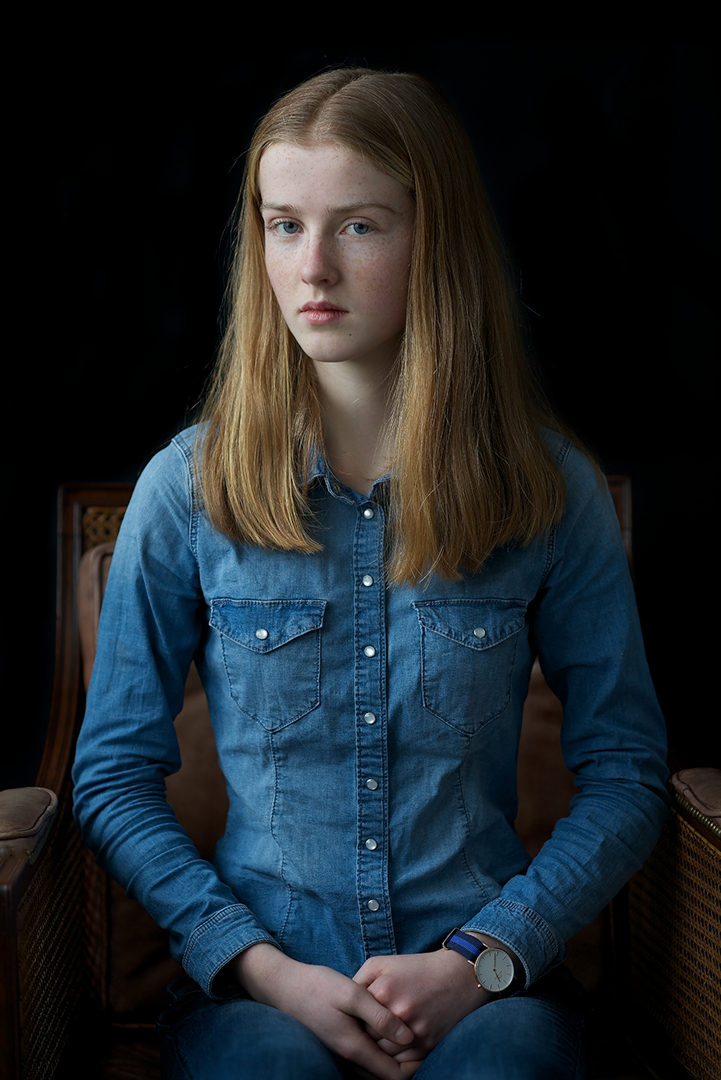
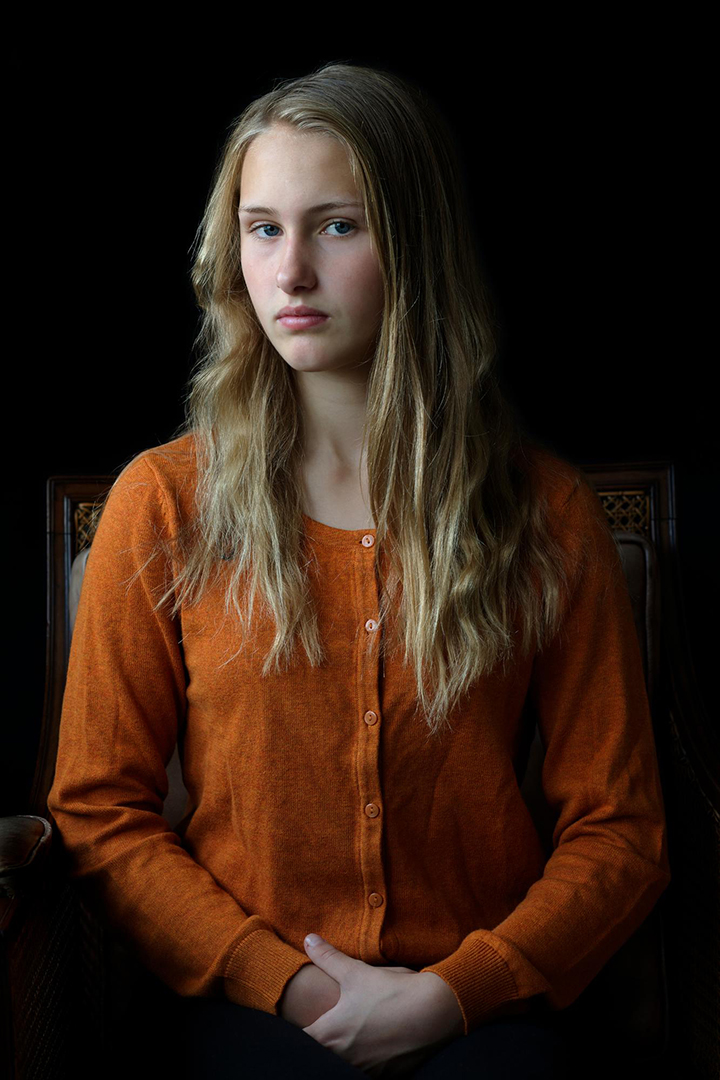
ARTHUR SOPIN: – Your piece “Common Sensibility” is a subtly haunting masterpiece! When one gazes upon your girls, an undeniable connection ensues; it reaches out instantly to touch not just the eyes but also the ears and other senses—I can almost hear the movements and sounds echoing from within the prints. It’s akin to a polite form of magic, where one wonders if a dove might unexpectedly emerge from the picture or if it will be a flame this time. You wield a gift akin to that of a magician, Joa! Why do you think we are drawn to the allure of play?
JO BENTDAL: – The game has much of the same as what I previously described as art potential. In the play, the boundaries are set to give form, substance, and meaning – not to restrict.
“In the game, one can withdraw from a certain framework at any given time -and choose another game. Life, in general, should be more like playing.”
ARTHUR SOPIN: – In “Common Sensibility,” you deftly blur the boundaries between war and peace, youth and age, tradition and rebellion, presenting a radical agenda that resonates profoundly, particularly in today’s context. We relish these moments with you! However, I’m curious to hear your opinion on humanity’s enduring aspiration for the ideal superhero akin to Superman. Is it achievable? Do we truly need it? Are there any exemplary figures thus far, and are there aspects we might overlook or have forgotten?
JO BENTDAL: – A culture has virtually unlimited potential – a potential to destroy everything and, simultaneously, a possibility for continuous positive development. The tools and discoveries we make could be used positively or negatively. But the transhumanist idea that man will take over for evolution and “improve” nature, which has created him, is, in my opinion, blatant idiocy. We might apply ourselves better to the fruits of innovation, but we must work hard to beat nature when developing living entities. It’s like learning a father to create children. This subject interests me, and I’m working on creating a series that treats this, but here and now, this will be everything I choose to say about the matter.
ARTHUR SOPIN: – Could you delve into the meanings of “common” and “sensibility” beyond their use in the name “Common Sensibility”? What do you find most captivating about each of these concepts?
JO BENTDAL: This is extensive. I recommend tasting the word and looking at what Wikipedia, Immanuel Kant, and Hannah Arendt say about the Sensus Communis. Another one, a bit random but funny connotation, is Thomas Paine’s “Common Sense” – When I replace “sense” with “sensibility” as a proposal for a “next level” version of the term “common sense.” An understanding that is more in keeping with the intuitive/analytic/spiritual synthesis I’ve poked in the interview…
“Maybe that for some can also act as an appeal for independence from an unnamed empire (not the British this time).”
ARTHUR SOPIN: – Let’s delve into motivation: what drives you? What mechanisms propel you towards self-fulfilment?
JO BENTDAL: – My goal is to have a good time – and fun – it presupposes that I can do what I believe is right. It presumes that I do not bluff myself, assumes that I operate in a context that works, and confirms that I’m not just doing it for myself.
ARTHUR SOPIN: – Are you aiming to spark a new movement by crafting a fresh Norwegian identity?
JO BENTDAL: – Hmmm … NO! – I’d like to help put people in motion, but not all in one direction. Instead of a continuous movement towards the core of which is them, at a given time – in a given context.
ARTHUR SOPIN: – Individual vs collective?
JO BENTDAL: – Yes, please- both!
ARTHUR SOPIN: – In your evaluation of heroines with the phrase “Everything we next deliver shall They acquire. With a new mindset?” we are amused here within the DT 500 MAG team; Joa, you could do stand-up comedy. Have you ever considered it? This assertion confronts a profound and unresolved dilemma in contemporary society, particularly among the younger generation. Joa, if faced with the choice, would you opt for a resilient sensibility or embrace a formidable challenge?
JO BENTDAL: – Demanding challenge! It’s much more fun (and safer).
ARTHUR SOPIN: –Do you think we will need the system in the future?
JO BENTDAL: – McDonald’s has strictly defined work routines that ensure a predictable (and a little sad) result despite less qualified employees. In a jazz trio, it is more freely forward -. Still, you know exactly what you are doing (have high qualifications), understand and respect the context, can adapt and can effectively communicate with the other members.
“I would rather live in a “jazz trio society” than a “McDonalds world .”
ARTHUR SOPIN: – It’s often stated: “We only live once.” Is that true, or might forces be attempting to deceive us? What are your personal thoughts on this matter?
JO BENTDAL: – We do, and so it should be – unless we go into the subjects of parallel realities and such, but the other truths are nevertheless 100% out of reach and only relevant for understanding how our existence may have come to be. So for all practical purposes, and outside afterparty mode: “it all adds up to normality” -Leonard Susskind.
ARTHUR SOPIN: – Could you delineate the characteristics of courage? Additionally, what are your views on traditions?
JO BENTDAL: – insight gives courage and prevents foolhardiness. Justified challenges to conventions are significant, and it is also good to understand and respect qualities that have made something a tradition. But in my worldview, nothing is sacred other than integrity (and it’s also entirely futile to challenge the laws of nature, but that principle manages itself and needs no symbolic definition as holy).
ARTHUR SOPIN:– Do we need a new national Idea in Norway? Would you try to define it?
JO BENTDAL: – A new national idea: Yes, more and many! I would define it: No – I believe in subjectivity in identity questions. My idéplattform is mine and should never be national! I hope other Norwegians have their ideas and do not buy everything in one place when building it out. I’m not a fan of uniformity – it is suboptimal and stupid.
ARTHUR SOPIN: –What has been the most inspiring event or development in Oslo or Norway to date?
JO BENTDAL: – My “night of the expanding man” was 5 years ago when I chose to focus on my own photo projects full-time. On the macro level, I struggle to think of any baffling event.
ARTHUR: – What is your most appropriate current quote?
JO BENTDAL: – Right now – here I am writing:
“I do it for my health; nobody feels me quite as much as I feel myself …..” from Watkin Tudor Jones Jr’s “Love is.”
ARTHUR: – What project are you currently working on?
JO BENTDAL: The working title is “The Law of the Instrument”. “Maslow’s Hammer” Is about excessive technology optimism, analytical hubris, and Superman, which I was asked about earlier in the interview.
ARTHUR: – See you around, bud! #Rapture! #dt50015minoffame

Interview by Arthur Sopin

Photography by Jo Bentdal
 #dt500mag