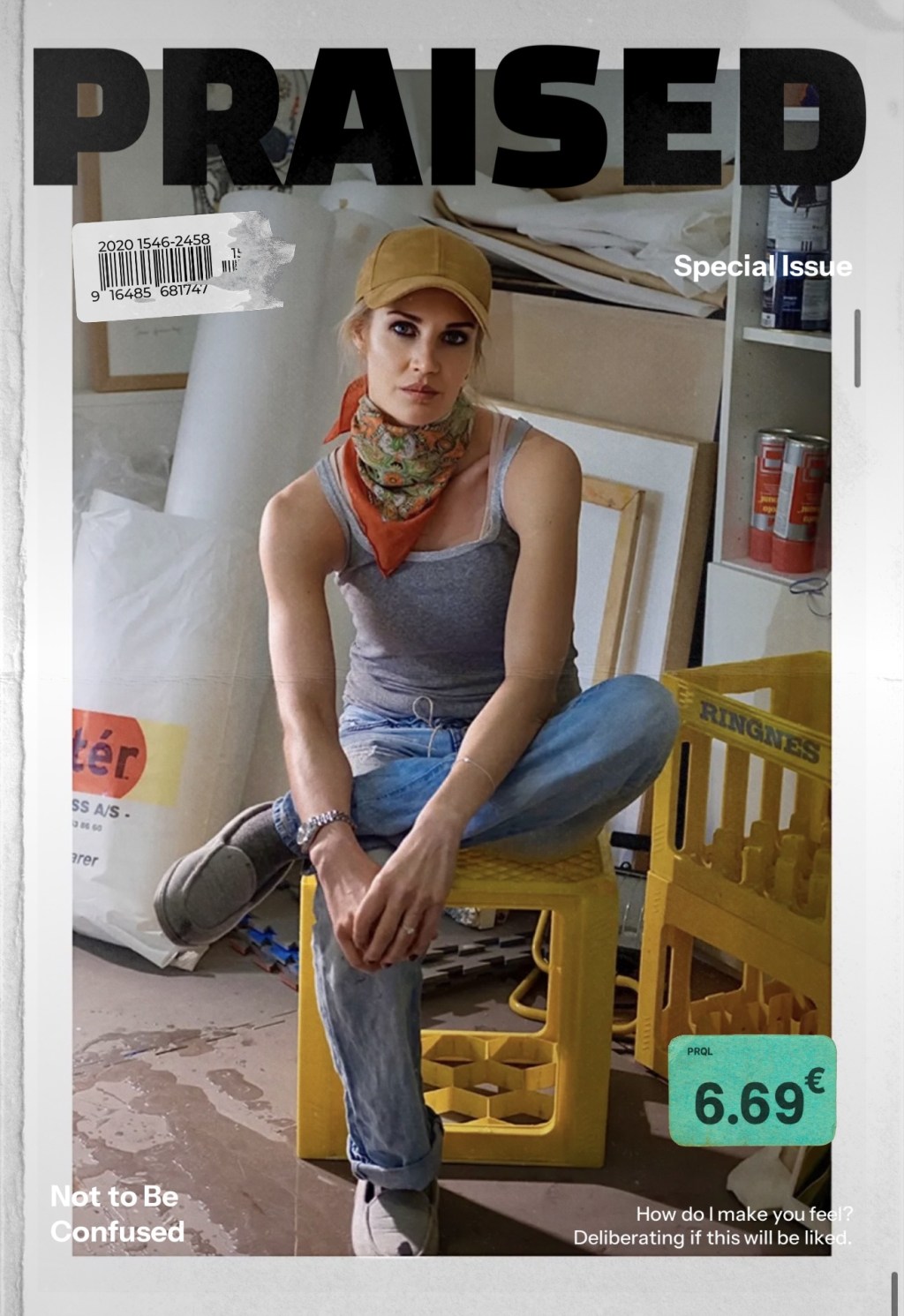

nside “ARNOLD” at Gallery A, Oslo — where bodybuilding meets classical composition and Photoshop becomes philosophy
There is a particular kind of confidence required to place Arnold Schwarzenegger inside a gallery and call it fine art without flinching.
Norwegian artist Benedicte Aubert Ringnes does not flinch.
Her exhibition “ARNOLD”, first presented at Gallery A in Oslo (20 October – 6 November 2016), operates somewhere between pop mythology, digital collage, and what one might generously call a post-internet rereading of classical form. Less generously, it is a meditation on image culture’s most enduring obsession: the body as symbol, aspiration, and spectacle.
Or, as Ringnes puts it with characteristic bluntness, the work
“just started by putting photos very roughly together. I liked it.”
That, in essence, is the system.
THE BODY AS ICON — AND OTHER MODERN PROBLEMS
At the centre of ARNOLD sits a simple but loaded proposition: what happens when masculinity becomes an image, and then that image becomes editable?
Ringnes takes Schwarzenegger—bodybuilder, actor, political artefact—and subjects him to a visual logic borrowed as much from Photoshop layering as from classical sculpture. The result is less parody than reconfiguration: the heroic body as fragmented file, endlessly adjustable, never quite stable.
Critic Lars Elton has noted that she “mixes famous photographs to redefine the visual universe,” turning iconic figures into psychological terrain. In ARNOLD, masculinity is neither celebrated nor dismantled so much as stress-tested under digital conditions.
It is pop art, yes—but with less Warhol gloss and more Scandinavian existential weather.
FROM SKI SEASONS TO SOFTWARE LOGIC
Ringnes’ route into this visual language is refreshingly unromantic.
Raised between Norway’s cultural institutions and an unusually early exposure to art and film, she recalls being taken to galleries as a child and later sent to art school in Denmark at 14. School, she admits, was largely tolerable only in very specific conditions.
“I have always hated school,” she says, “except for art class, gym, and FRIMINUTT.”
A brief pause for translation: friminutt is Norwegian recess. Even rebellion, it seems, is structured.
After school came a period of skiing, travel, and what might be politely described as drift, before she attempted to study film production in Australia. It is here that the aesthetic grammar of ARNOLD begins to take shape.
“I visualise a moving image when I hear music,” she says. “Shapes, colours, a storyline following the beat.”
Her influences are unapologetically high-definition: Chris Cunningham, David Bowie, Jonas Åkerlund, Michel Gondry. The language is not fine art tradition, but music video logic—compressed narrative, heightened emotion, and deliberate artificiality.
One suspects she would find Renaissance perspective mildly underwhelming.
PHOTOSHOP AS PHILOSOPHY (OR AT LEAST AS METHOD)
If there is a conceptual backbone to Ringnes’ practice, it is not theory but software.
She describes early experimentation with digital composition—layering, editing, recomposing images—until the work began to behave less like illustration and more like construction.
“I can have up to 80 layers,” she says. “At that point, each segment is treated for lighting, composition, and balance.”
Perfection, however, is not the goal.
“If it becomes too perfect, the point of appropriation fades away.”
It is an unexpectedly precise critique of digital aesthetics: the closer the image approaches resolution, the less interesting it becomes.
In other words, error is not failure. It is texture.
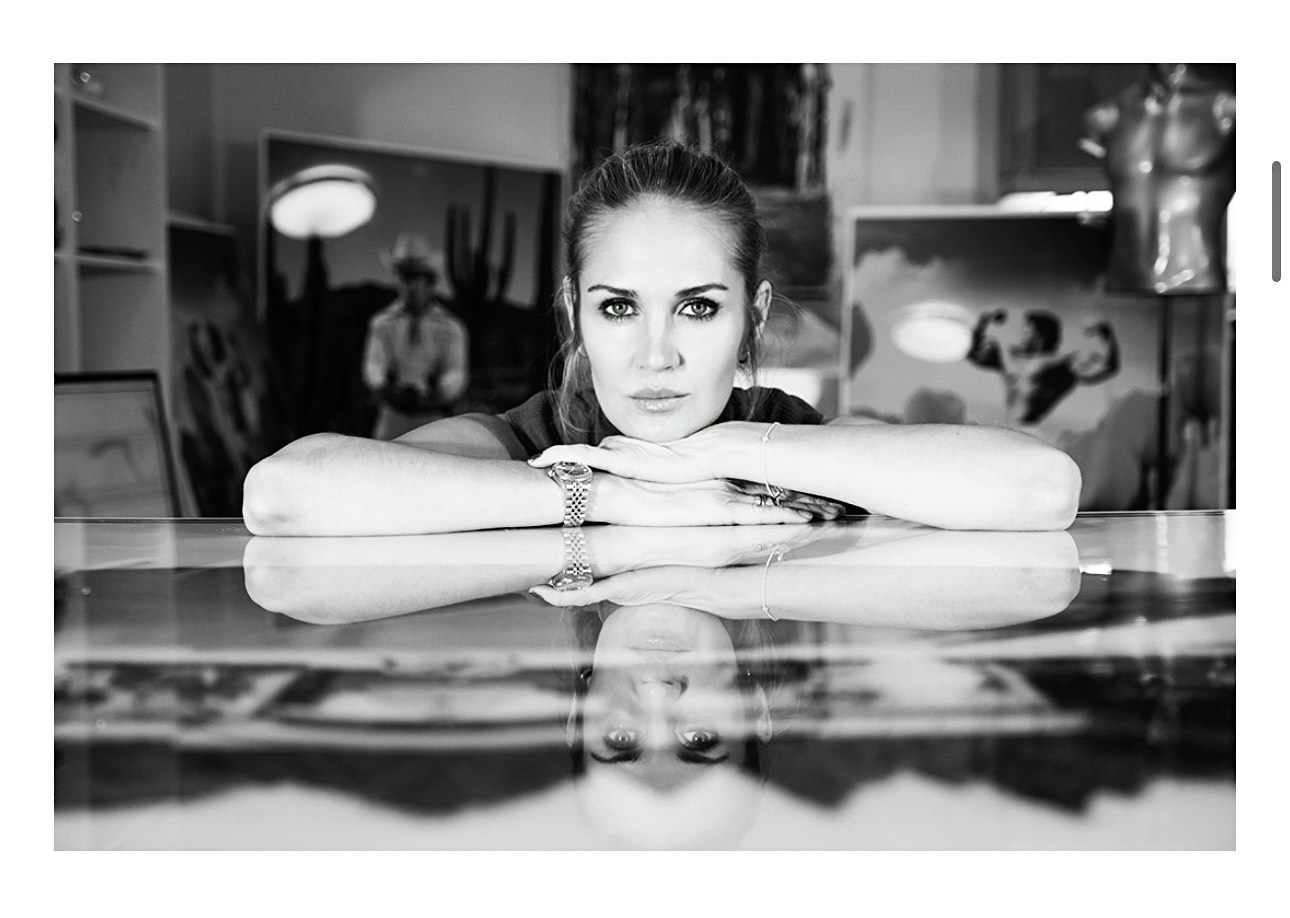
ARNOLD SCHWARZENEGGER AND THE QUESTION OF FEMININE STRENGTH
One of the more quietly subversive readings within ARNOLD is its treatment of bodybuilding as choreography rather than brute force.
Ringnes is interested in the training behind the spectacle: posture, symmetry, and presentation. She draws a direct line between competitive bodybuilding and classical sculpture.
“Bodybuilding is more feminine than one would think,” she says. “It’s about shaping, symmetry, and caring for your body.”
She notes that Arnold Schwarzenegger trained under guidance that included stage movement and even ballet-informed presentation. The comparison, for her, is not ironic but structural.
The body, whether carved in marble or sculpted in muscle, obeys similar aesthetic laws: proportion, discipline, control.
The difference is only medium.
THE ARTIST, THE SYSTEM, AND THE REFUSAL TO SETTLE
Ringnes is notably unconcerned with disciplinary boundaries.
She has worked across film, photography, and installation, yet is blunt about institutional constraints.
“In film, you have to fulfil many wishes to get funding,” she says. “Art gives me control and freedom.”
This is not romanticised autonomy. It is pragmatic frustration turned into methodology.
At one point, she abandoned a planned project entirely, returning instead to earlier sketches of Arnold Schwarzenegger.
“I just said, fuck it,” she recalls. “It’s going to be a pure ARNOLD exhibition.”
The decision was made without committee, consultation, or—crucially—permission.
One suspects this is not unusual for her.
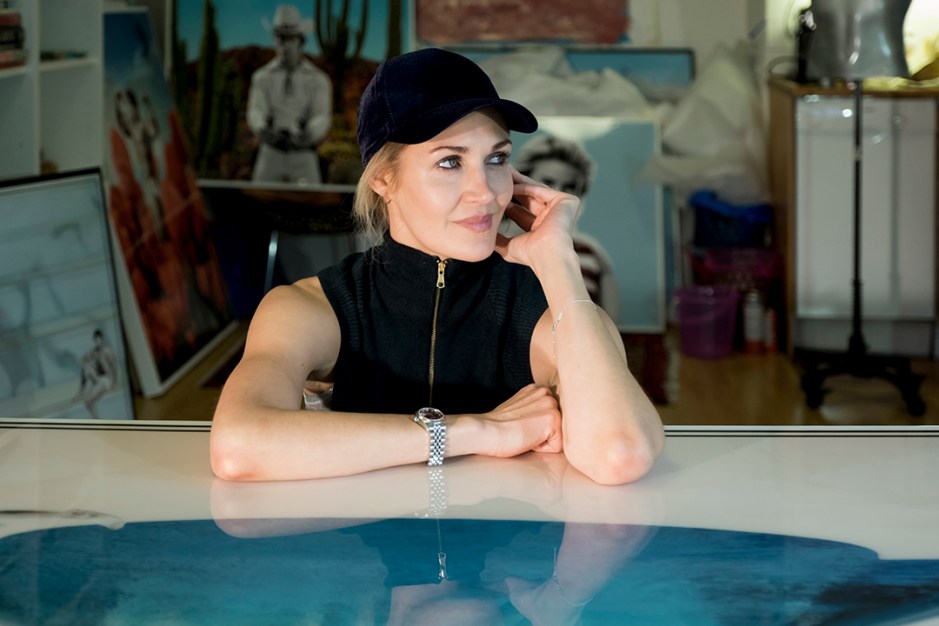
POP ART, BUT WITH LESS COMFORT
Ringnes is frequently positioned within a pop-art lineage, though she resists any neat categorisation.
She cites Richard Hamilton and David Hockney, but also surrealism and Nordic expressionism. Her relationship to pop art is less inheritance than friction.
“Pop art is using me,” she says. “Not the other way around.”
It is delivered half in jest, but the point is sharp: appropriation is no longer a style. It is the default condition of visual culture.
The question is not whether images are reused, but how consciously they are rearranged.
THE EXHIBITION AS QUESTION, NOT ANSWER
At Gallery A, ARNOLD does not attempt resolution. It stages collision: masculinity and softness, control and distortion, celebrity and abstraction.
Schwarzenegger becomes less figure than framework—an entry point into questions about how bodies are constructed visually, culturally, and psychologically.
Even the artist resists definitive interpretation.
“He is a symbol,” she says simply. “The rest is open.”
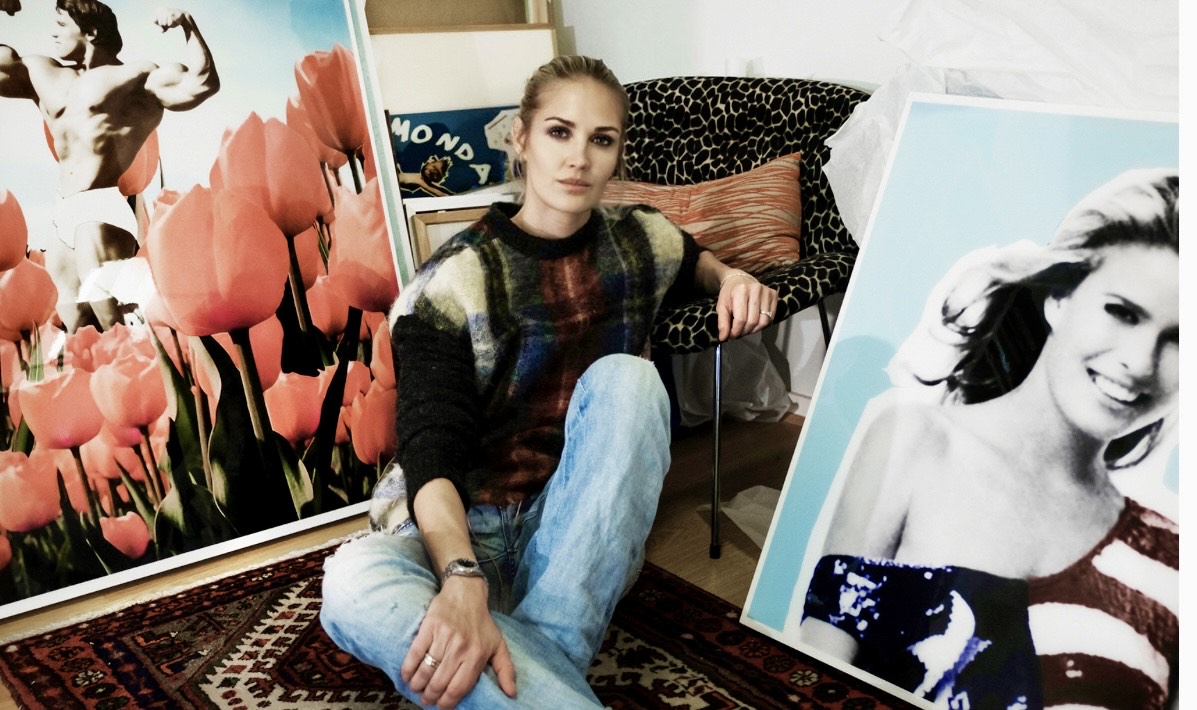
WHAT COMES NEXT
Ringnes declines to elaborate on future projects.
“I don’t feel like sharing ideas too early,” she says.
It is perhaps the most artistically orthodox thing she says.
FINAL NOTE
ARNOLD ultimately sits in a familiar but still productive tension: between image-making as play and image-making as critique.
Ringnes does not resolve this tension.
She edits it, layers it, and lets it remain visible.
In a contemporary culture saturated with polished meaning, that refusal to finalise may be the most deliberate gesture of all.
Press Contact:
The exhibition ARNOLD by Benedicte Aubert Ringnes can be seen from October 20 to November 6 at GALLERY A, Vibes gate 13 -Oslo
Photography Andreas Rod
Interview Arthur Sopin
 #dt500mag