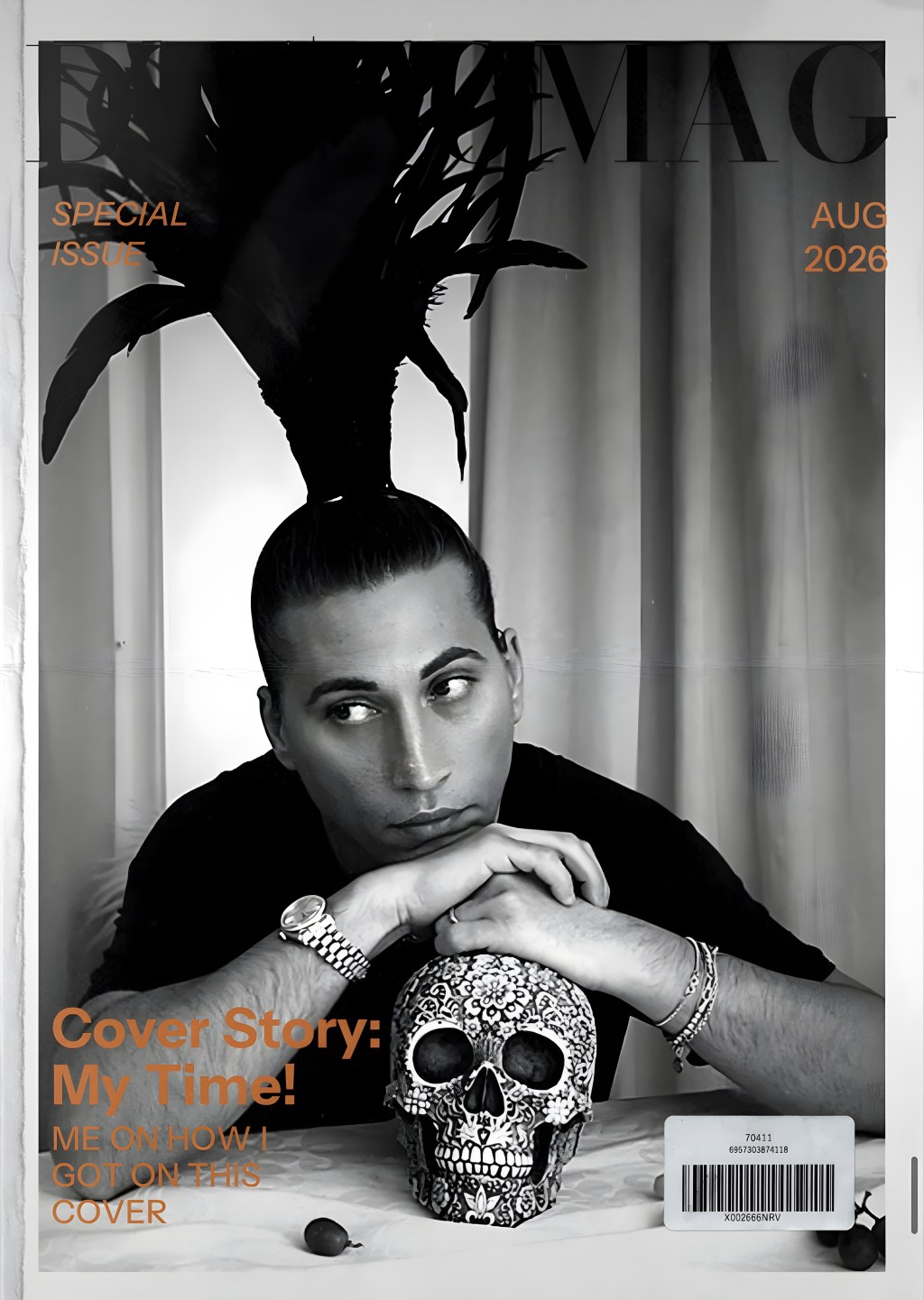

In the ever-expanding theatre of contemporary fashion—where everyone is allegedly “iconic” before lunch—James Lazar Braathen occupies a rather more interesting position: slightly outside the spectacle, but still very much inside the room. The kind of designer who appears in your periphery and quietly rearranges the furniture.
At DT 500’s red sofa conversation, Braathen is introduced as a kind of creative force reshaping the local fashion landscape, already worn by recognisable Norwegian names and publicly scored the kind of “six out of six” approval usually reserved for extremely obedient dogs or unusually successful national projects. One hesitates to ask which category applies.
Still, he seems unfazed by any of it.
JAMES LAZAR BRAATHEN
DT 500 MAG: James, readers are eager to understand your journey. Where does it begin?
JAMES LAZAR BRAATHEN: I find myself at the beginning of a long and exciting trip. I look at the red carpet and see passionate silhouettes wearing gala dresses á la James Lazar.
He pauses, then adds the sort of sentence that sounds like it should be embroidered somewhere expensive:
“I do not want to lock myself down to anything. Identity is something I would like to daydream about.”
Which, frankly, is a far more honest position than most branding strategies.
DT 500 MAG: When you think of the woman who embodies your work, who do you see?
JAMES LAZAR BRAATHEN: Victoria Beckham is my muse.
There is a brief silence in which one imagines Beckham herself politely declining to comment.
DT 500 MAG: Tell us about silhouette and identity.
JAMES LAZAR BRAATHEN: I am very obsessed with the female body, the shapes, and the lines.
“The silhouette is tight and ambient, very playful and erotic. The identity enjoys the class with a rare aesthetic sense. She is free and owns her power.”
One gets the impression that “tight and ambient” is either a revolutionary design theory or something lost in translation between atelier and enthusiasm.

DT 500 MAG: Your work is described as delicate and refined. What drives it?
JAMES LAZAR BRAATHEN: I love freedom and mystery. When I start making a dress, I become totally obsessed. The inspiration takes control.
“I can work for ages. You need to be creative to understand it.”
A sentence which conveniently excludes most of humanity, including—on difficult days—fashion editors.
DT 500 MAG: You speak about elegance, feminism, and passion. Is that the foundation?
JAMES LAZAR BRAATHEN: Yes. Always three things. Elegance, feminism, and passion.
It sounds almost too structurally reasonable for something so emotionally ungoverned, but he delivers it with conviction.
DT 500 MAG: And Oslo—what does it mean to you creatively?
JAMES LAZAR BRAATHEN: I have little time to realise that I am living in Oslo. I think I live more in my own head. I see everything on a large scale—beyond national borders.
Which is reassuring, given the collection has already been seen at Østbanehallen and within the orbit of Norway’s fashion establishment.
He adds, almost casually:
“I like to take a walk and gather inspiration in local architecture, colours, and interiors. Frogner especially—I find many treasures there.”
One imagines these “treasures” are not necessarily the gift-shop variety.
DT 500 MAG: How do you define your aesthetic world?
JAMES LAZAR BRAATHEN: I love freedom and mystery. I become obsessed when I start a dress. Sometimes I am inspired by a lady beside me—naturally elegant, regal, dramatic.
“I am fond of fashion from the 20s to 30s, Russian czarinas, embroidered silk, crystal chandeliers…”
At this point, one begins to suspect history is less a reference and more a mood board with delusions of grandeur.
DT 500 MAG: What is the message to women in your work?
JAMES LAZAR BRAATHEN: I want to match feminine nature with exclusive fabric design. Every woman should look into her soul and find her own passion.
“I would like to guide the female physique with silk or lace.”
A sentence which feels like it should come with either a warning or a very expensive perfume campaign.
DT 500 MAG: Technology, fashion, the future—robots versus humans?
JAMES LAZAR BRAATHEN: Technology is a tool. I use it, but I don’t believe it will take over. Fashion will adapt.
“I am not afraid something will disappear—only that it will change.”
Which, in fairness, is probably the most rational thing anyone has said so far.
DT 500 MAG: Keywords for your designs?
JAMES LAZAR BRAATHEN: Style. Passion. Womanliness.
Naturally.
He adds, almost as an afterthought:
“Everything I make can be used in both contexts. Function and fantasy must balance.”
One imagines this balance is occasionally negotiated at 3am with scissors.
DT 500 MAG: Any superpowers?
JAMES LAZAR BRAATHEN: Berocca gives me superpowers. And dancing. Good music. Everything except hard rock.
Which feels, in a very Scandinavian way, like a policy statement.
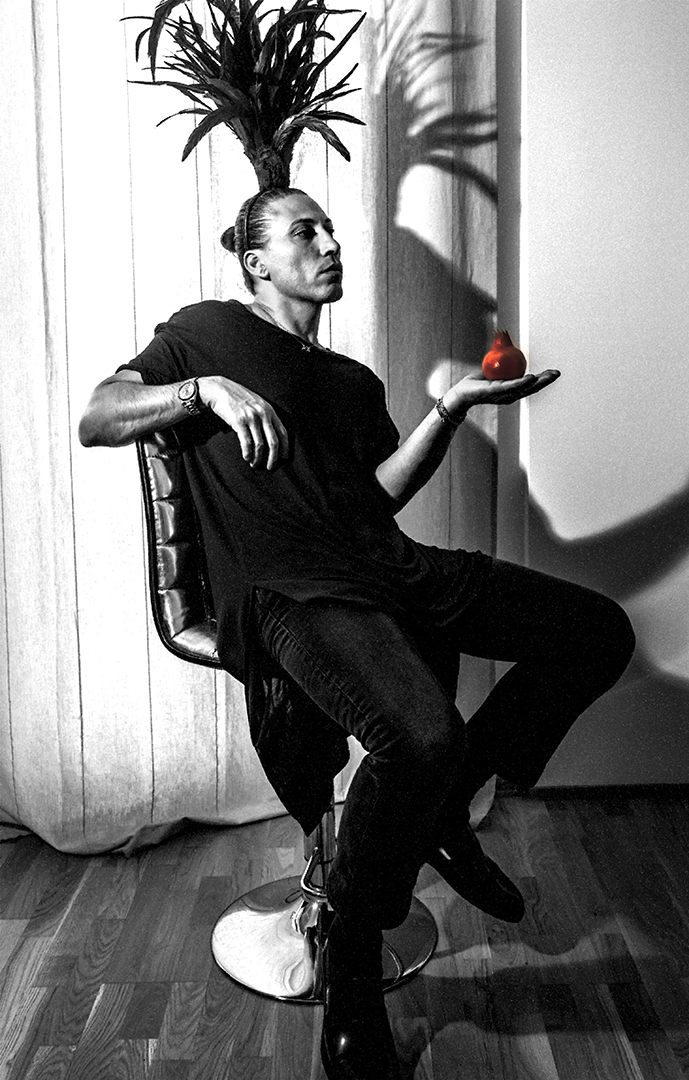
James Lazar Braathen’s DT 500 interview positions James as a designer operating between myth-making and material reality, where identity is treated less as a fixed narrative and more as a fluid, almost daydreamed construction. His work—worn by Norwegian public figures and validated within the local fashion circuit—emerges through a language of obsession, silhouette, and controlled femininity.
Across the conversation, Braathen frames fashion as a space of elegance, feminism, and passion, while resisting fixed definitions of identity or national categorisation. Oslo appears not as a stylistic influence but as an internalised, almost abstract landscape filtered through architecture, memory, and personal mythology.
The result is a portrait of a designer who merges theatrical romanticism with pragmatic craft, oscillating between sincerity and stylised abstraction—anchored in Norwegian fashion culture, but deliberately unconfined by it.
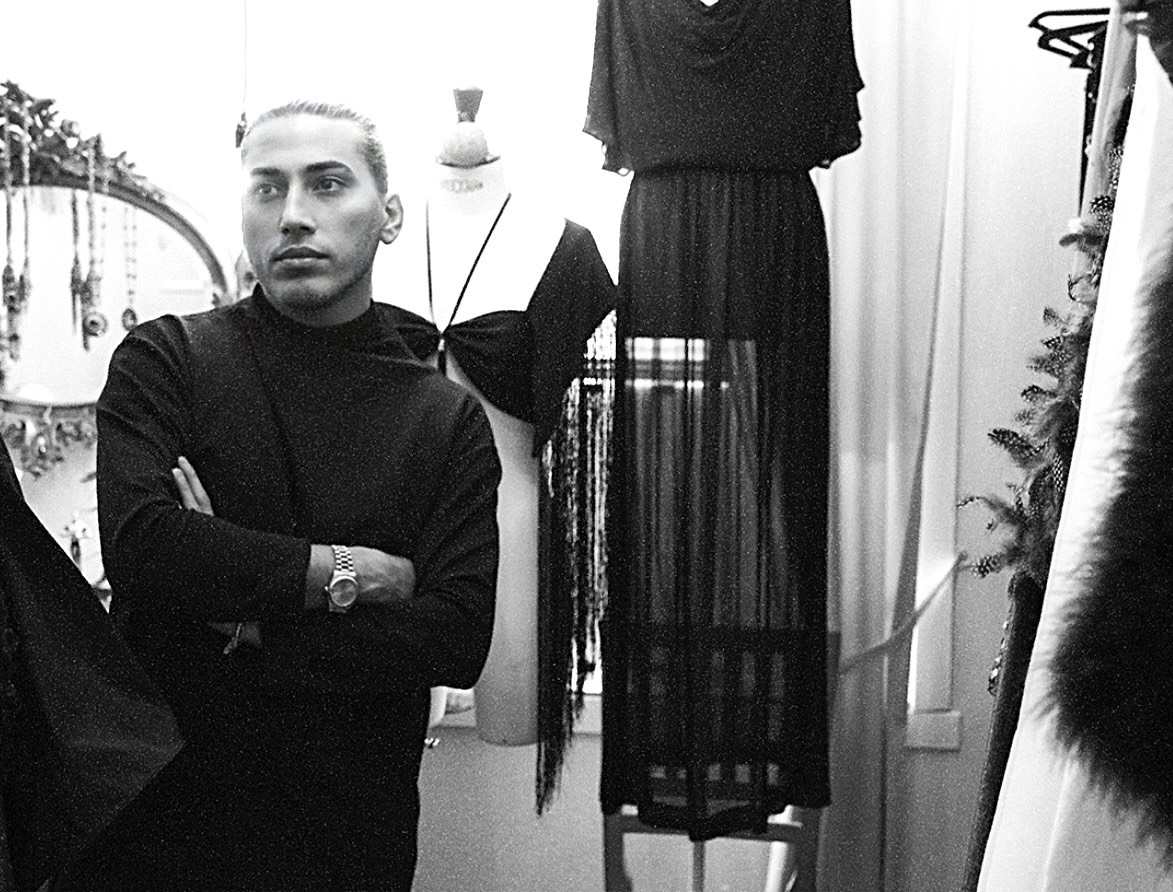
#RAPTURE!
Interview by: Arthur Sopin and Andreas Rød
Photo by: Andreas Roed
 #dt500mag