
Morten Viskum, a visionary artist known for his provocative and contemplative works, continues to ignite discourse and introspection with his latest exhibitions and retrospectives. Hailing from a lineage of profound creativity and a background rooted in veterinary science, Viskum has carved a distinctive niche in contemporary art that confronts societal norms and existential inquiries head-on.
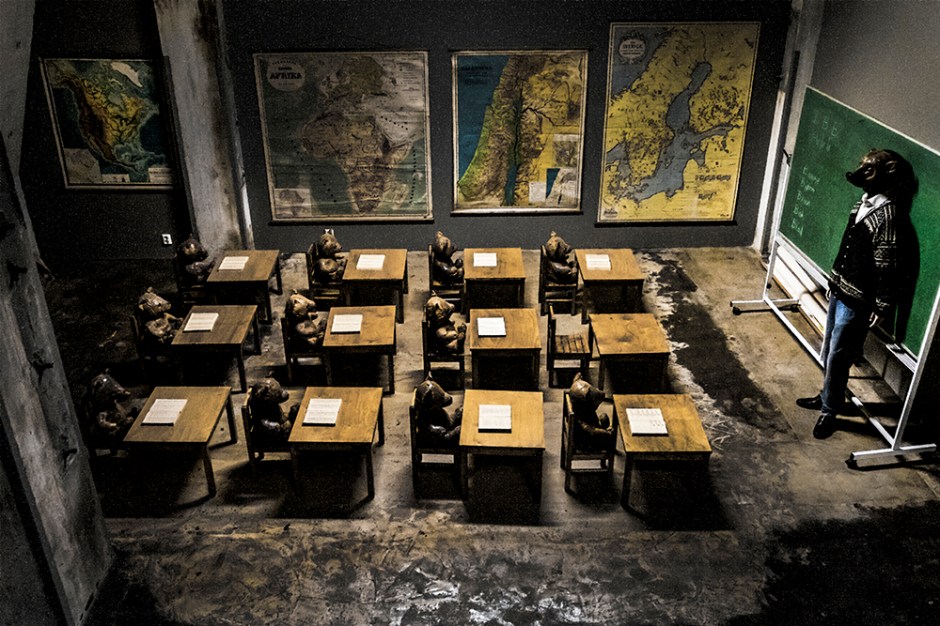
Drawing inspiration from the ethos of Young British Artists (Y.B.A.) such as Damien Hirst, Tracey Emin, and Marcus Harvey, Viskum’s oeuvre challenges viewers to engage deeply with themes of life, death, religion, and politics. His artworks often incorporate visceral elements such as deceased animals, human body parts, and organic materials like blood and cancer cells, deliberately urging audiences to reconsider their perceptions and ethical standings.
“Morten Viskum’s art compels us to scrutinize our own beliefs, emotions, and moral compass,” remarks Arthur Sopin, an art critic closely following Viskum’s trajectory.
“His ability to provoke and stimulate dialogue about the role of art in society is profound and thought-provoking.”
Viskum’s journey into the art world was a decisive shift from his early career in veterinary studies, a path he pursued at the urging of his grandfather. “I had always dreamed of being an artist,” recalls Viskum, reflecting on his transition.
“My fascination with the natural world, coupled with a deep-seated interest in human and animal anatomy, eventually steered me towards art as my true vocation.”
Central to Viskum’s artistic philosophy is the idea of art for everyone, transcending traditional boundaries of elitism or purely aesthetic appreciation. His artworks, often described as scandalous and bombastic, compel viewers to confront uncomfortable truths and explore the intricate relationship between art and societal norms.
“In a world increasingly shaped by technology and rapid change, Viskum’s work serves as a poignant reminder of our humanity and the profound questions that define our existence,” notes Andreas Rod, a photographer who has documented Viskum’s exhibitions extensively.
Viskum’s impact extends beyond the confines of traditional galleries; his ongoing project at Pere Lachaise in Paris, where he photographs grave portraits, underscores his commitment to exploring the timeless themes of mortality and remembrance.
As Viskum continues to evolve as an artist and cultural provocateur, his retrospectives like “Absolut Viskum III” stand as a testament to his enduring influence and commitment to challenging artistic boundaries.

MORTEN VISKUM
DT 500 MAG – Embarking on the genesis of your artistic journey, Morten, could you reflect on the formative influences of your childhood play?
MORTEN: – I was always more interested in the process than the results. As a child, I was more of a nerdy type; I enjoyed my own company, building things, using my hands, making sand palaces, destroying them and creating them again. The process was the most important to me than the goal. I had fun with matchbox cars, building roads, bridges, etc.
DT 500 MAG: – Could we liken your youthful pursuits to those of a budding creative engineer, perhaps?
MORTEN: – More like an architect, I was more concerned with ideas and visions than solid results…
DT 500 MAG: – Are there any anecdotes from your past that might provide a fresh perspective on your artistic evolution?
MORTEN: – It all started so long ago. I remember myself; nature fascinated me, so dead birds did as well; in 5th grade, my friends and I were doing bird-ringing, which inspired me. I also remember some impressions I got from art pieces. I remember an exhibition of Yves Klein from one time I went to a museum as a small boy. He made art using flames.
DT 500 MAG: -Morten, having pursued six years of veterinary studies before transitioning to the art academy, could you elaborate on what prompted such a profound shift in your career path?
MORTEN: – I had always dreamed of being an artist. However, my grandfather advised me that I should get a more profound education and do art when I had finished instead. I started veterinary school and did very well for some years, but I was always more interested in art. I was way more interested in animal nature than in Latin names. My private art interest was still dominating. Making the grand switch took some time, but in the end, I just couldn’t reject myself.
DT 500 Mag: -Morten, could you delve into your fascination with rats and how it influences your artistic vision?
MORTEN: – I did ”RATS / OLIVES PART I” in 1995; when that happened, my family fully understood that I would never become a veterinarian.
” The thing with the rats is not so visual but conceptual; it is essential that the rats once were alive. “
DT 500 MAG: – Are there other animals or subjects that intrigue you similarly?
MORTEN: -I also tried to work with cats and puppies, but the concept was too intimate for the audience and could be discussed too quickly.
” So I started working mainly with rats, which would be easier for people to translate directly into their understandings. I want to question the reality that many people don’t want to identify themselves with.”
DT 500 MAG: – Yes, it is a dilemma…
MORTEN: The Norwegian Embassy in India would buy my work if I was willing to change the title to “Blood, Cancer Cells and Colour I .” I made 2 versions; the other one is called ”Beauty .”
DT 500 MAG: – Tell us, Morten, about your fascination with the remnants of life, with those parts that linger after the last breath has fled. What draws you to these fragments of mortality?
MORTEN: – As a veterinary student, I got used to studying animal corpses, from horses to insects. In 1996, I made an artwork with a pig head installation for the Fall exhibition.
“ The visitors met and talked to me, and many people asked me why I had chosen a dead animal. I answered because I couldn’t get a human body. From that moment on, I started involving human bodies in my artworks.”
DT 500 MAG: – Pray, Morten, do divulge the tale of your inaugural acquisition of a hand for your esteemed collection?
MORTEN: – That is a mystery! It had to lay in formalin for six months before I could use it. For a while, I doubted the project. After six months, I could finally use the hand, and I made a painting named “The Hand that Never Stopped Painting I .“ 17 years later, I still use this hand in some projects.
” I even did an exhibition where my visitors could choose if they wanted to see or not when I was drawing with the hand.”
DT 500 MAG: – Forgive the peculiar nature of the inquiry, but may I inquire as to how many hands grace your collection?”
MORTEN: – I have 7 different hands, 2 women’s hands and 5 men’s.
” I did a painting named ”Rest In Peace” made by the hand of a 22-year-old man, who took his own life.”
DT 500 MAG: – What sensations do you encounter when employing the hand of someone who has departed this realm or traversed into other dimensions?

MORTEN: – First, I want to say that I treat all my human and animal parts with the utmost respect.
“I have been contacted by a few new-age groups as well, asking me if I am falling into a trance like a shaman, and I have to say that no, I do not.”
DT 500 MAG: – Could you share from where your inspiration emanates?
MORTEN: – I let the history inspire me, Yes.
“I had an exhibition in Venice once, and the local police officer was really destructed by my hands; I am a Protestant, and we have a bit of a different view on things than Catholics, so I don’t see this as a requiem, it has a whole other status for me. I use 50/50 human or animal organs.”
DT 500 MAG: – In your artistic endeavours, one observes the inclusion of provocative figures such as Breivik, alongside motifs of hands, coffins, and rats — elements that might challenge the orthodox mind. Morten, what fuels your creative vision?
MORTEN: – I have a work named “SELF-PORTRAITS.” It’s a series of myself in various stages. Every year on my birthday, I ordered a silicon cast specially made for me in a particular pose.
DT 500 MAG: –Certainly, we are captivated by it. For those eager to explore, a journey to Vestfossen beckons. Morten, could you delve deeper into the narrative behind this extraordinary artistry?
MORTEN: – The cast becomes a part of an even more massive installation in which I present myself in various contexts. I once posed as Jesus, and NRK followed me around at my exhibition in Paris. I have also acted as a Scientist, reflecting more of my science background, a “Perfect Sculpture,” where I visualised the body fixation in our society and a Financier – I made myself into a man crushed by the financial crisis of 2008. I named it ”NO WAY.” I made my own Breivik after the tragedy of July 22nd, 2011. I thought for a while and decided to present him as a clown in his typical clothing style. The Breivik figure has only the hair and beard a la Breivik; the rest is truly mine. In 2010 I even performed myself as a Transvestite.
DT 500 MAG: -Morten, as this year unfolds, are there any newcomers poised to make their debut in your artistic narrative?
MORTEN: – This year, I had my Jubilee of 50 years, and I made myself as Charlie Chaplin; I was inspired by “Charlie Hebdo.” This work is exhibited in England today. My next exhibition will show all the copies in the Haugar Art Museum.
“I am not a rebel. I want to show reality, and that reality is something not every person can manage.”
DT 500 MAG: –I’ve heard whispers dubbing you a neo-dadaist. How do you respond to this fashionable label for your artistry?
Morten: – I would not choose a neo-dada as a denotation. I have been called a maximalist. Actually, I do not care about names and brands. Well, this is your job… I want to inspire; whatever name comes out of that is up to the audience!
DT 500 MAG: – Are there any buzzworthy art gigs making waves in town today?
MORTEN: – These are fascinating times for Oslo and Norway. Today, you can experience whatever you wish. On the 29th of February 2014, I joined the Norwegian Freemasonry. It gave me a sense of peace that helped me sort out my thoughts and supported me to be a better, more compassionate person. It is a closed community, and not just anybody can participate. Both my father and grandfather were members.

DT 500 MAG: – You’ve amassed quite a collection of personal artworks. Care to share a few favourites?
MORTEN: – There is a woman named ROSE WYLIE; she is English, and I have always been fascinated by her works. I met her, and we had a stimulating dialogue. I bought a few art pieces of hers, which hang over my bed today. She presents a kind of Primitive Art with very unique romanticism. Her work is candid; she makes things we already know feel new. Rose demonstrates an organic approach to the materiality of paintings, her playful virtuosity matching with great power.

DT 500 MAG: – In the ever-evolving realm of modern technology, Morten, how do you view its intricate dance with human potential and creativity? Does it amplify our capabilities or impose limitations, perhaps even reshaping the very fabric of artistic expression?
MORTEN: – I remember when the first mobile phone came out, I paid 15 000 kroner for it, which was huge! Today, we use iPhones….but I don’t think we can go ahead forever with technology.
“It will bring more possibilities, sure, you can do whatever you want at any time. Our phones bring us closer to ourselves, but sometimes, it can go wrong when we use technological devices rather than talking to people in person. A smartphone is a convenient tool in everyday life, but turning it off can sometimes be extremely liberating.”
DT 500 MAG: –What is your perspective on Oslo these days? How does the city inspire or influence your artistic journey?
MORTEN: The Astrup Fearnley Museum is doing some exciting events these days; it is essential for Oslo. Otherwise, I would thrive well in “Dagligstuen” with my dear friend Unni Askeland.
DT 500 MAG: – Looking ahead, Morten, what can we expect from you next? Are there new projects or exhibitions on the horizon?”
MORTEN: – I have a project going on at Pere Lachaise In Paris, where I look after graves of the dead and take photo portraits of the pictures on the graves. This is a project I will never end. There is always a new grave. I am also a General Manager at VESTFOSSEN ARTLAB. My studio, my office, and my gallery are there. It’s where my whole job takes place. I will probably work there for 5 or 10 years until I find a strong leader to take over. After that, I can go on to become a full-time artist.
DT 500 MAG: – WATCH OUT! Morten’s exhibition at FINE ART GALLERY is coming.
Morten Viskum emerges as a visionary artist, curator and collector, steeped in two decades of navigating the avant-garde. His artistry navigates profound existential inquiries using unconventional canvases—deceased creatures, human remains, and controversial personas—eliciting global contemplation. Having traversed from veterinary sciences to the art academy, Viskum challenges societal norms, inviting audiences into a realm where intellect melds seamlessly with artistic expression. The forthcoming showcase at FINE ART GALLERY promises an immersive odyssey through the depths of human consciousness, a testament to Viskum’s transformative impact on the art world.
ABSOLUT VISKUM III
RETROSPEKTIV 1993-2016, 7-17 APRIL 2016
© interview by Arthur Sopin and photography by Andreas Rod


 #dt500mag